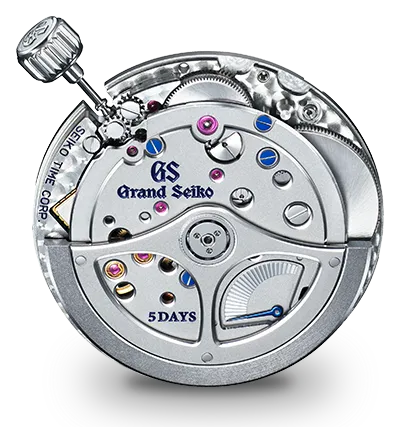
Turn an automatic watch over and a semicircular piece of metal will usually obscure half the movement behind the display back. Move the case and the semicircle turns. Sometimes it follows the wrist slowly, sometimes it races around, and sometimes it barely moves.
This is the rotor. Its purpose sounds simple: use movement from the wrist to wind the watch.
The rotor itself, however, winds nothing. It is not a generator, a battery or a small flywheel driving the hands directly. It is a deliberately unbalanced weight. Turning that motion into useful energy requires a reversing system, gears, clicks, a mainspring barrel and a clutch that protects a fully wound watch from its own wearer.
Automatic winding is not one component. It is an energy-transfer chain.
The rotor in motion
Move the watch and follow the energy from the rotor through the reverser and gear train into the mainspring.
The model loads only when you start it.
Move the illustrated watch and follow energy from rotor to mainspring. Original schematic model.
A centre of gravity that is not in the centre
A rotor is a rotating mass supported at the centre or at another point of the movement. Its weight is not distributed evenly around the axis. The outer arc is thicker and heavier, placing the centre of gravity away from the pivot.
Turn the watch slowly and gravity encourages the heavy section to remain at the bottom. The case moves around it, so the rotor changes position relative to the movement. During a quick wrist action, inertia also contributes: the case has already changed direction while the rotor continues travelling.
Not every movement produces a complete revolution. It does not need to. A turn of only a few degrees can still be transferred into the winding train. All day, an automatic watch collects small, disordered movements and organises them towards one result: increasing tension in the mainspring.
The rotor does not create free energy. It takes a tiny share of the wearer’s muscular work. A person sitting motionless at a desk winds a watch less than somebody walking all day. “Automatic” does not mean that the watch will run forever under all conditions. It means that wear can replace some or all of the energy being consumed.
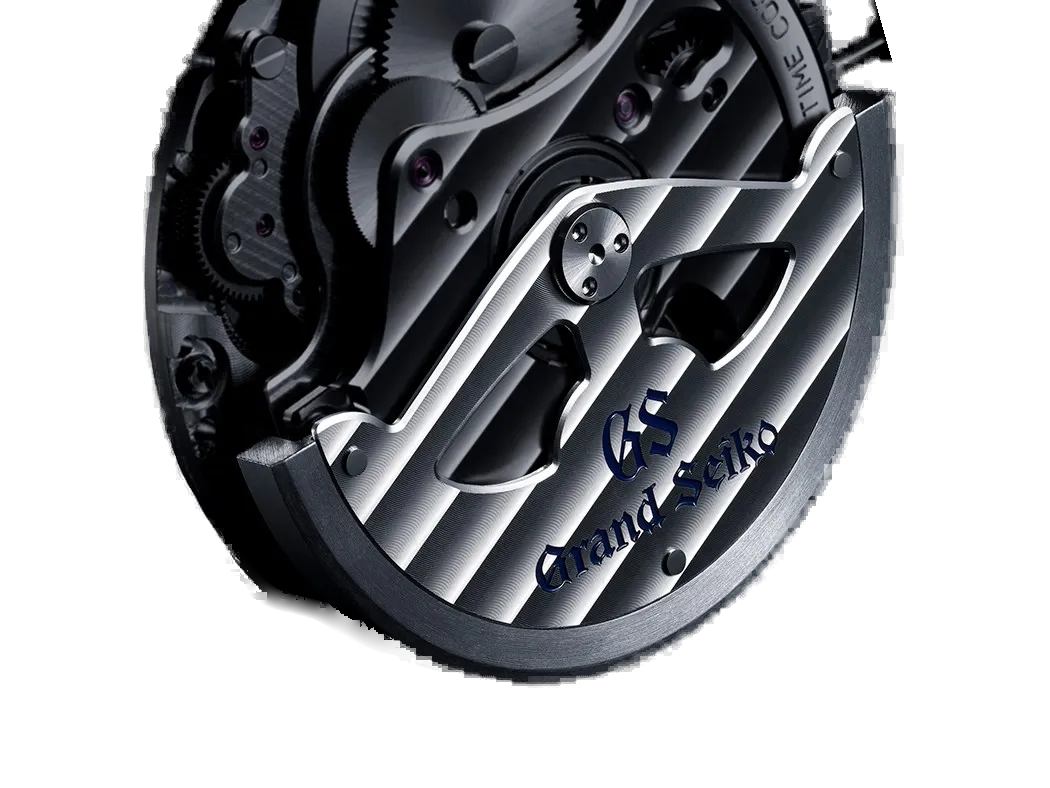 Mass is concentrated along the rotor’s outer arc, allowing it to turn relative to the movement even when the case moves only slightly. Photo: Grand Seiko, background removed.
The gear that has to choose a direction
The rotor can turn both ways. A mainspring can only be wound in one direction. The movement must therefore do three things:
- receive the rotor’s irregular motion,
- direct it the useful way,
- change speed and torque enough to wind the spring.
The simplest systems use only one direction of rotor travel. When it turns the useful way, a click or freewheel engages and drives the winding wheels. In the other direction, the connection releases and the rotor returns freely. Such a watch can still wind effectively, though part of its movement is not transferred to the spring.
Bidirectional systems use reversing wheels. They switch the route so clockwise and anticlockwise rotor movement both turn the barrel’s winding wheel in the same direction. Rolex’s pair of interconnected reversing wheels, patented in 1952, is a well-known example.
There are other solutions. Seiko’s Magic Lever from 1959 uses two arms. One pulls and the other pushes the winding wheel, then they exchange roles when direction changes. It uses few components and captures small rotor movements, which is why it became fundamental to many Seiko calibres.
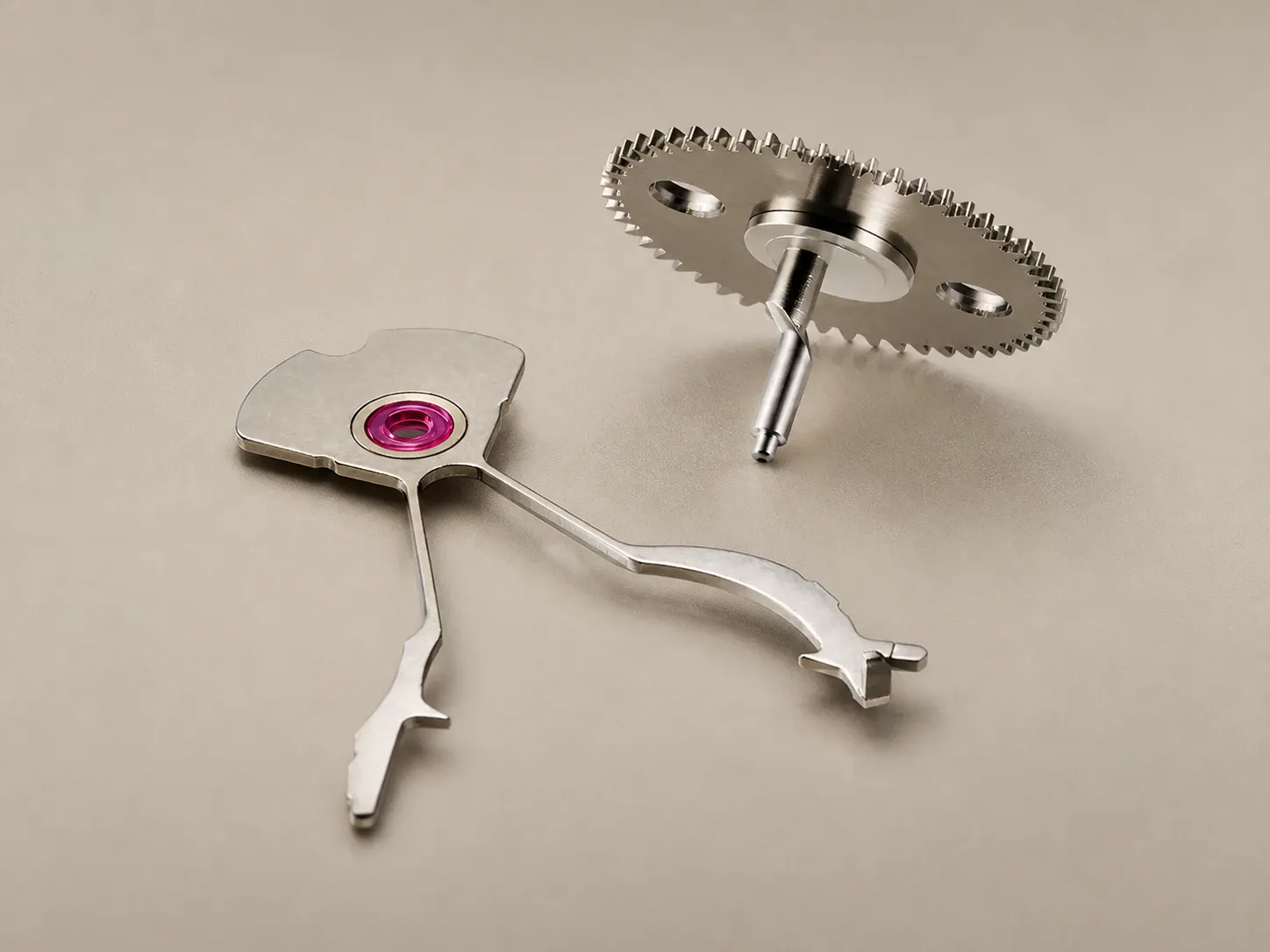 The two Magic Lever arms transmit clockwise and anticlockwise rotor motion in the same useful direction. Image: Grand Seiko, brightened and clarified with AI assistance.
IWC’s Pellaton system also uses pawls. An eccentric converts rotor rotation into a back-and-forth action, while two pawls alternately pull the winding wheel or slide over it. The objective is the same: whichever way the rotor starts, the mainspring receives winding.
Different routes perform the same act of organisation. The wrist moves at random. The spring understands one direction.
A barrel is not a battery, though it behaves like one
The gears eventually carry energy to the barrel, a flat, toothed drum containing a long metal spring. During winding, the mainspring coils more tightly and stores energy through elastic deformation.
While the watch runs, the spring relaxes slowly. It turns the barrel, which delivers power through the going train and escapement to the balance. The rotor does not drive the hands directly. It first charges this mechanical store, and the watch later uses its contents at a controlled rate.
That is why an automatic watch continues to run after it is removed. Power reserve states how long a fully wound movement can operate without further motion. It might be about 38 hours in an older basic calibre, 70 or 80 hours in many modern movements, and several days in specialised constructions.
A longer reserve does not automatically mean a more efficient rotor. It also depends on spring length, the number of barrels, balance frequency and the energy requirements of the entire movement. The winding system only determines how efficiently energy returns to storage.
Why it does not break when the rotor keeps turning
In a hand-wound watch, the outer end of the mainspring is fixed to the barrel wall. Once the spring is tight, resistance can be felt through the crown. That is the signal to stop.
An automatic watch cannot rely on the wearer. The rotor keeps moving when the spring is full. If its outer end were fixed rigidly, the next forceful wrist movement could overstress or break it.
The answer is the slipping bridle. The outer end of the mainspring is connected to a resilient blade held against the inside wall of the barrel by friction. Under normal tension it grips firmly enough for the spring to wind. At full charge, rising tension overcomes the grip and the bridle slips a short distance along the wall. Rotor and gears can continue to move without tightening the spring beyond a safe level.
It is a mechanical clutch. There is no sensor, electronic control or shut-off switch, only carefully chosen friction.
For this reason, a correctly functioning automatic watch cannot be overwound through normal use. The slip may sometimes produce a faint periodic sound during hand winding when the spring is already full. If the bridle slips too easily, the watch will not reach its full reserve. If it sticks, excessive tension can build. The condition of this invisible clutch is therefore a servicing matter too.
A rotor is not always a large semicircle
The most common arrangement today is the full central rotor. It turns above the movement, allows substantial mass to be placed on its outer arc and connects simply to the winding train. Its disadvantages are that it obscures much of the bridges and adds thickness.
A micro-rotor sits within the plane of the movement. Because it is smaller, it is often made from a dense material such as tungsten or gold. It leaves more of the back visible and can produce a thinner watch. The available space, however, must provide sufficient mass and gearing, making design more demanding.
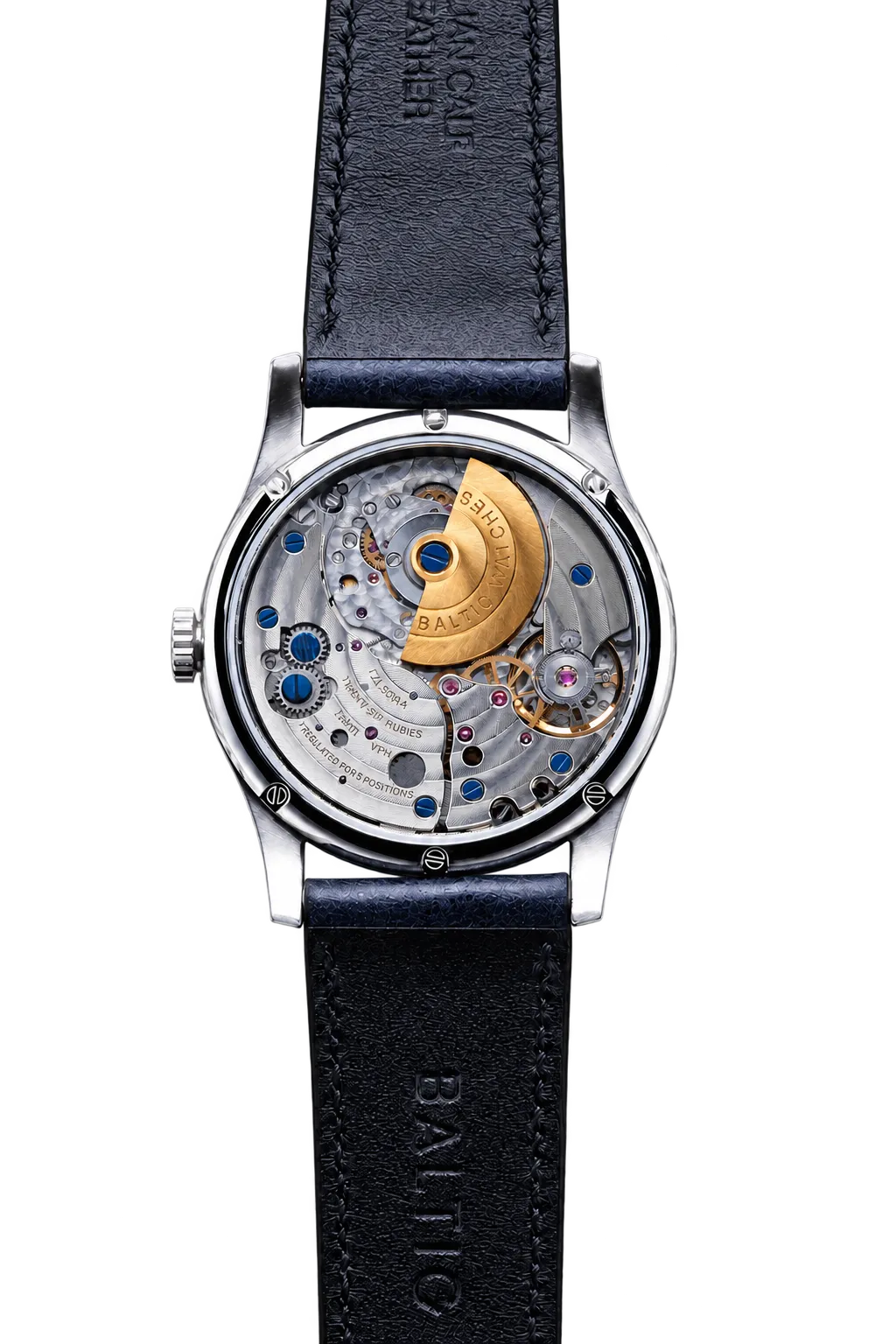 The gold-coloured micro-rotor in Baltic MR01 turns within the movement rather than above it, leaving most of the bridges visible. Photo: Baltic, modified with AI assistance.
A peripheral rotor runs as a ring around the outside of the movement. It leaves almost everything visible while moving its mass at a large diameter. Its bearings, shock resistance and manufacture are complex, so it remains uncommon and expensive.
There have also been hammer, or bumper, automatics. Their weight did not complete a circle. It travelled through a limited arc, struck spring-loaded stops and returned. Wearers could often feel a gentle knock at the wrist.
A pocket-watch problem and a wristwatch answer
Self-winding is far older than the wristwatch. Abraham-Louis Breguet sold his first reliable Perpétuelle pocket watch in 1780. An oscillating platinum weight wound two barrels from movement of the owner. Motion inside a pocket was limited and unpredictable, however, and such watches remained rare and expensive.
The wrist created a new situation. It moved more frequently through a larger arc, while the mechanism had to fit into much less space.
John Harwood patented his automatic wristwatch in 1923. Its hammer weight travelled through a restricted angle, and the hands were set by turning the bezel rather than a crown. Production began in the late 1920s before the economic depression ended the company.
In 1931, Rolex patented its freely rotating, 360-degree Perpetual rotor. This became the familiar architecture of the modern automatic watch. The weight could travel farther and collect movement more smoothly, while the screw-down crown of the Oyster case needed to be opened less often. In 1952, reversing wheels added bidirectional winding.
The rotor did not arrive in one moment. Pocket-watch weights, Harwood’s bumper and Rolex’s full circle were different answers to the same question: how can human movement be stored without asking the wearer to think about it?
What we are actually watching through the caseback
The rotor is the largest moving part behind a display back, so it is easy to think it performs the important work. In reality, it is only the entrance to the system.
The rotor collects disordered motion. The reverser organises it. The gear train turns it into useful torque. The barrel stores it. The slipping bridle releases the excess.
None of these steps is spectacular alone. Together, they solve a surprisingly human problem: we forget to wind a watch.
The automatic movement did not eliminate that daily action. It hid it inside the way we walk.