Two runners set off together. The first crosses the finish line while the second is still a few strides behind. With an ordinary stopwatch, you have a choice: stop at the first finish, or keep it running and try to remember where the hand was.
A split-seconds chronograph removes that choice. Press a button and what looked like a single seconds hand separates into two. One stays at the first runner’s time. The other keeps going until the second finishes. Stop the whole measurement and both results remain on the dial.
That is the purpose of a rattrapante. The French name refers to catching up: another press releases the stopped hand and brings it back into alignment with its companion. It does not return to zero or begin a new measurement. The hands simply show the same elapsed time again.
There are not two stopwatches inside
It is tempting to imagine a watchmaker fitting a second stopwatch beside the first. In fact, both hands work from the same timebase. Having separately stoppable hands does not require two balances or two dedicated mainsprings.
The extra task begins at the chronograph display. A second central hand must normally follow the first, yet stop independently when asked. Their connection has to be secure enough for synchronized travel but releasable enough that holding one does not stop the other.
This is why simply fastening the hands together, or connecting them through a rigid gear train, would not solve the problem. The mechanism needs two different operating conditions: aligned movement, and independent movement with one hand held still.
A clamp and an unusually shaped cam
The hands sit on concentric arbors. In Lange’s technical drawing, the chronograph hand is carried by an outer tubular arbor, with the split-seconds arbor running inside it. Almost none of this layering is apparent from the dial.
A key part of their connection is the heart cam. Rather than meshing teeth, its shaped surface guides a follower. The cam turns with the chronograph; the spring-loaded follower belongs to the split-seconds wheel. When engaged, they allow the hands to travel together.
Press the split pusher and a small clamp holds the split-seconds wheel. The chronograph wheel continues turning. Release the clamp and the follower settles back into its defined position against the cam, realigning the split hand with the chronograph hand.
It does not count back the elapsed seconds or replay every missed step. Re-establishing the mechanical connection restores the alignment. That is why the rejoining movement is so quick.
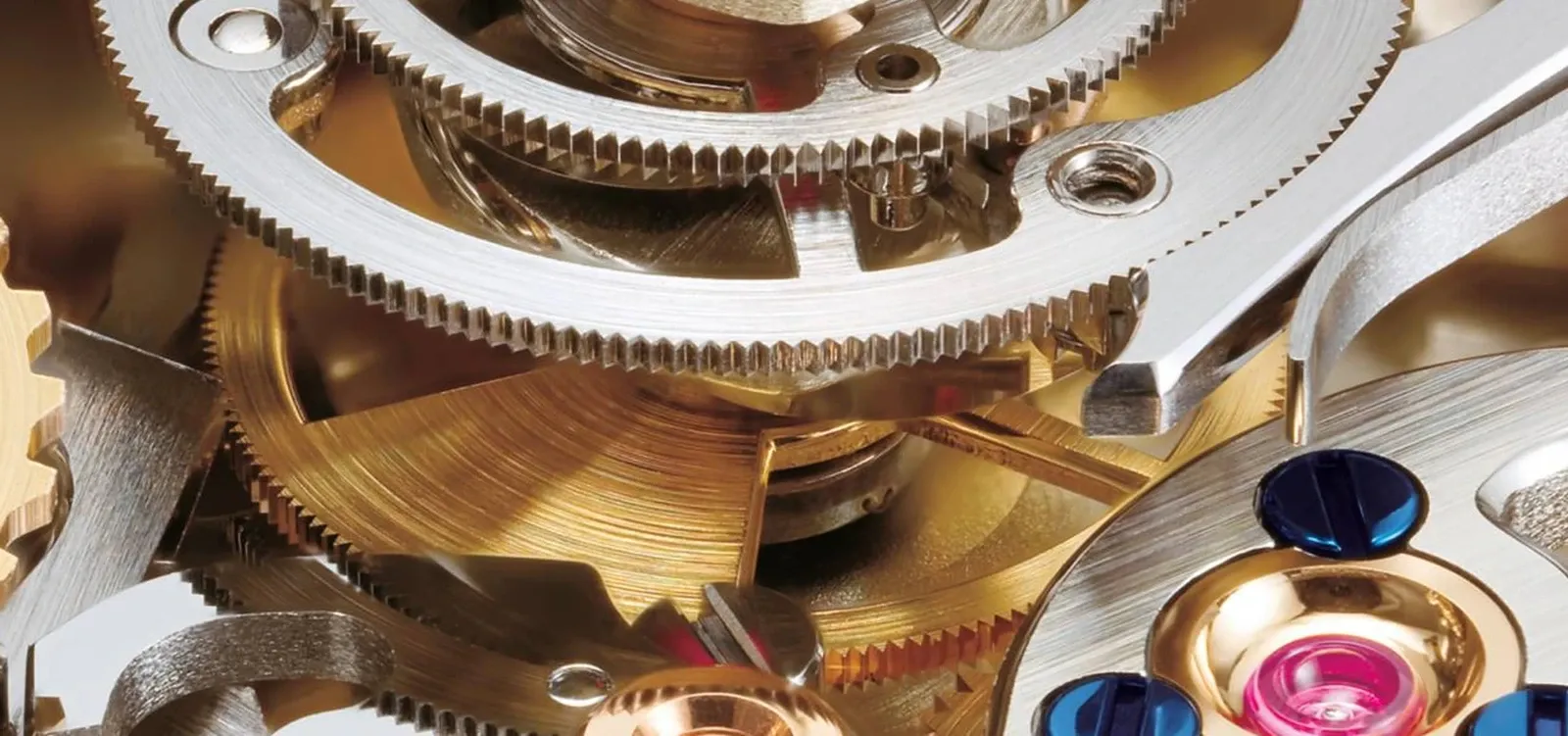
A detail of L001.1 from the official Double Split presentation. Its wheels and levers occupy several levels; their arrangement is not reproduced by the educational model below. Photography: Lange Uhren GmbH.
Why holding the wheel is not enough
The heart cam continues turning beside the stopped split-seconds wheel. If the follower remained in contact, the rotating surface would keep displacing it against its spring. That would impose an unnecessary load on the movement.
An isolator addresses this by lifting the follower away from the cam while a split is held. The clamp retains the reading without making the rotating part work against the follower. On release, the connection is restored.
The construction varies between manufacturers. Patek Philippe’s technical description of reference 5204, for example, presents its own isolator system and a revised heart-cam profile. Lange provides disengagement for both the seconds and minute split mechanisms in the Double Split. Not every rattrapante is mechanically identical.
The slender concentric arbors and the clamp closing from two sides also demand careful adjustment. An arbor rubbing against its neighbour, or a clamp gripping incorrectly, can affect more than the appearance of the hands. The challenge is not simply finding room for another hand on the dial.
Try it with two finishers
Start with Load example in the model. The split hand is held at 12 seconds and the chronograph hand at 18. Both measurements began together, so the difference is six seconds. You did not have to write down or remember the first result.
Now press Catch up. The hands align without resetting the elapsed time. To try your own measurement, reset, start and hold a split after a few seconds. The mechanism view shows the clamp closing and the follower lifting away.
Two finishers, one stopwatch
Hold one hand while the other keeps timing. Beside the dial, see the mechanism that retains the intermediate time.
01 / What you read
02 / What happens inside
Start the timer or advance it by hand. Both hands are aligned.
The first finisher arrives at 12 seconds, the second at 18. The difference is 6 seconds. Use Catch up to align the hands, then start a new measurement.
What do the moving parts represent?
- The inner heart cam turns with the chronograph. A spring-loaded follower transmits its motion to the split-seconds wheel.
- For a split reading, the outer jaws grip the split wheel. The follower lifts away from the still-rotating cam, illustrating the isolator’s function.
- On release, the clamp opens and the follower returns to the cam, aligning the hands. Real rejoining is rapid; this model shows the resulting position.
An educational model with one pair of seconds hands, not a scale replica of L001.1. The minute counter, flyback, column wheel and isolator control parts are omitted. Cam profile and lever travel are illustrative. No friction or rate accuracy is simulated. No autoplay; manual stepping is available.
Manual stepping works without starting the animation. Use +1 second to work through the sequence at your own pace, including with the split hand held. This model explains one pair of seconds hands, not the complete Double Split. Its 60-second demonstration limit does not mean a real chronograph cannot time beyond a minute.
There is another useful distinction. If you read intermediate times at 12 and 18 seconds, the latter is not automatically a new six-second lap. The hand still indicates time since the common start. To obtain the interval between those readings, you subtract one from the other.
The Double Split retains the minutes too
A conventional split-seconds hand completes a circuit in one minute. Held still, it shows a position within that minute, but cannot tell you how many full minutes had elapsed. Meanwhile, the chronograph minute counter may keep advancing, so it does not necessarily preserve the minute reading that belonged to the earlier split.
A. Lange & Söhne’s Double Split, introduced in 2004, addressed that limitation. Alongside the central seconds pair, it added a split hand to the minute counter. Capturing a split retains both seconds and minutes, extending comparative timing to 30 minutes.
Imagine one runner finishing in eight minutes twelve seconds and another in nine minutes eighteen. Two large seconds hands alone would not show the complete difference. The extra minute hand preserves the minute component of both results. This is where the Double Split becomes more than a visually elaborate version of a familiar complication.
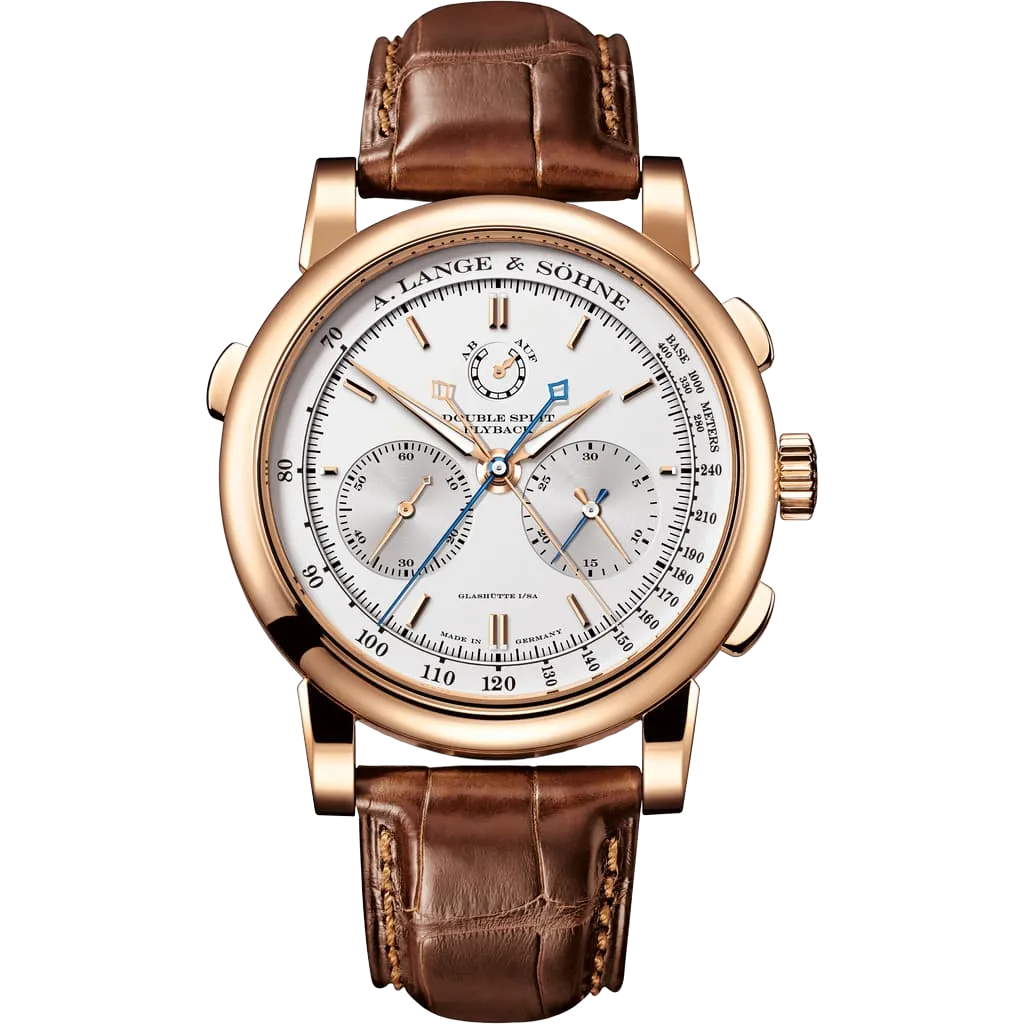
Double Split, reference 404.032. The lower-right subdial also has two hands for the minutes. Photography: Lange Uhren GmbH. AI-assisted extraction mask; original photographic watch details retained.
The pink-gold case of reference 404.032 measures 43 mm across and 15.3 mm high. Its manually wound L001.1 calibre contains 465 components, runs at 3 Hz and has a 38-hour power reserve. The component count covers the entire movement, not just the split function. Lange no longer lists this reference as part of its current collection.
The thickness makes it clear that this is not a watch designed to disappear beneath a shirt cuff. What appeals to me is the contrast between its restrained face and the task behind it. The two central hands are easy to overlook; their smaller counterparts on the minute counter draw even less attention. Yet those small hands are what extend its capabilities.
Catching up is not flyback
The Double Split dial also carries the word flyback. This is not another name for rattrapante.
Flyback allows a running measurement to be reset and restarted immediately. It is useful for timing successive stages separately: finish one measurement and begin the next, without stopping, resetting and starting the chronograph through three separate actions.
Rattrapante retains the common starting point. It holds an intermediate reading while the other hand continues the same measurement. Flyback returns the timing hands to zero; the split function returns one hand to its companion. The Double Split offers both, but they do different jobs.
How far can the idea go?
The underlying idea long predates Lange. Winnerl was developing hands that could be stopped separately and resynchronized in the first half of the nineteenth century. Those early arrangements lacked the convenient zero-reset function we now take for granted. The rattrapante emerged through a long development, rather than as the invention of a single modern brand.
Lange later extended its own double mechanism. The Triple Split of 2018 added a second hour-counter hand, taking comparative timing to twelve hours. The manufacturer’s September 2026 chronograph overview features a new platinum Triple Split. The principle remains recognizable: where one measurement keeps advancing, another must retain an earlier position.
A phone can do this far more easily and store many more results. That does not make the rattrapante less interesting. Few complications connect their use to their mechanism so clearly: the push of a button, the stopping hand and the closing clamp are three views of the same action.
The next time you notice two seconds hands resting together, imagine the moment one stays behind. Something inside the case is doing more than stopping. It is keeping one result available while allowing the timing to continue.