On December 25, 1969, a wristwatch went on sale in Tokyo for 450,000 yen. That was roughly the price of a popular Japanese car. Its case was made of 18-carat gold, its surface was finished by hand, and only a small number existed during the first months.
It did not look like a cheap electronic device. There was no plastic case, digital display or row of flashing buttons. Three hands moved over a restrained gold dial. The seconds hand, however, did not glide. It made one distinct step every second.
The watch was the Seiko Quartz Astron 35SQ. It was not the first quartz timekeeper, nor was it the first quartz wristwatch prototype. It was the first one placed on sale.
A lead of one day can be enough to make history.
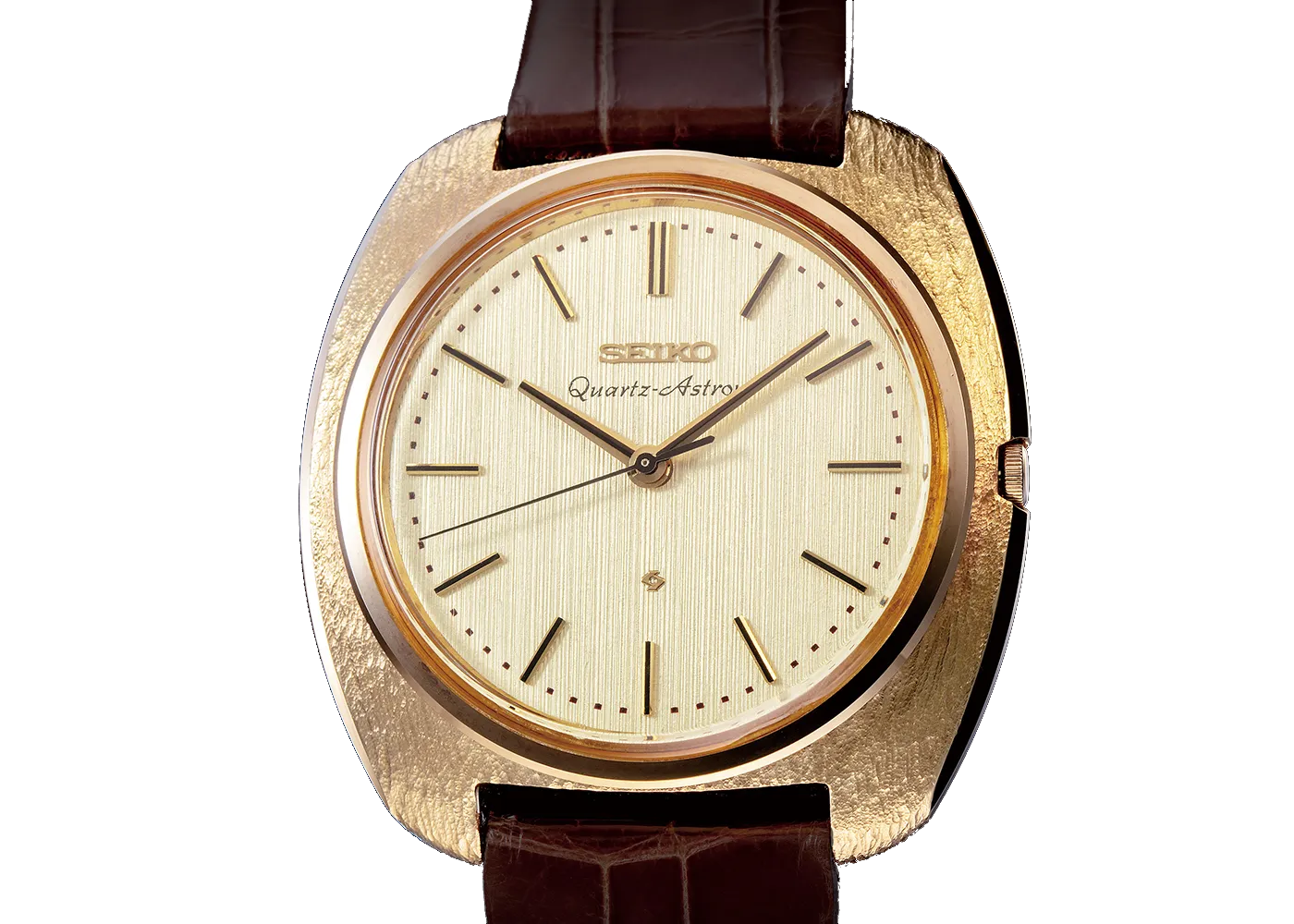 The 1969 Seiko Quartz Astron 35SQ in an 18-carat gold case. Photo: Seiko; background extraction: Lume.
The accurate clock that was the size of a cabinet
The idea behind quartz timekeeping was not new in 1969. Apply an electric voltage to a properly shaped quartz crystal and it vibrates at a remarkably stable frequency. Those vibrations can provide a much more consistent reference than the balance wheel of a mechanical watch.
The problem was not the principle. It was the size.
By the late 1950s, Seiko was already building quartz clocks for broadcasting stations. The equipment was about as large as a filing cabinet. It did not have to survive shocks, temperature changes or the constant movement of a human wrist. It only had to be accurate while standing still.
This had to become a wristwatch.
In 1959, Suwa Seikosha, the predecessor of today’s Seiko Epson, launched Project 59A. Its goal was a quartz movement powered by a 1.5-volt battery. Development did not begin on the wrist. Table clocks came first, followed by portable chronometers. Seiko quartz technology was used for timing at the 1964 Tokyo Olympics, and by 1967 the company had completed a wristwatch-sized prototype.
That did not yet mean it could be manufactured as a product.
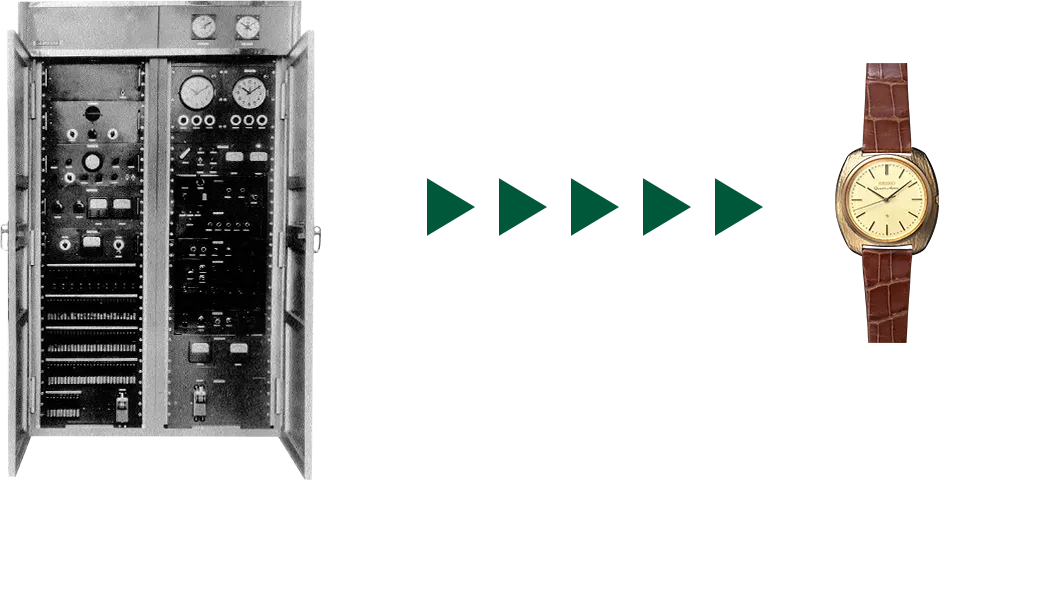 From a cabinet-sized broadcasting clock to the Calibre 35A wristwatch movement. Seiko says the mechanism was reduced to one three-hundred-thousandth of its original volume. Image: Seiko.
Ten years spent solving a watch made entirely of problems
In a mechanical watch, the balance oscillates and the escapement releases the gear train in small steps. In a quartz watch, the vibration of the crystal first has to become an electrical signal. That signal must then be divided until a single useful pulse remains each second. Finally, a motor has to turn that pulse into the movement of the hands.
Today this is ordinary technology that costs very little. In the 1960s, every part of it was a separate development problem.
The crystal had to be made small without becoming unstable under shock or changing temperature. Seiko shaped its tuning-fork oscillator with photolithography and acid etching, sealed it inside a vacuum capsule, and used a newly developed variable capacitor to compensate for temperature.
The electronics were not yet a nearly invisible modern integrated circuit. The early 35SQ used a hybrid circuit with transistors, resistors and capacitors mounted on a ceramic substrate. All of it had to run without exhausting the battery in days.
The motor was also too large and too power-hungry. The final stepper motor used a coil of 20-micrometre copper wire wound twenty thousand times. It turned sixty degrees for every electrical pulse, while the entire movement consumed only 18 microamps.
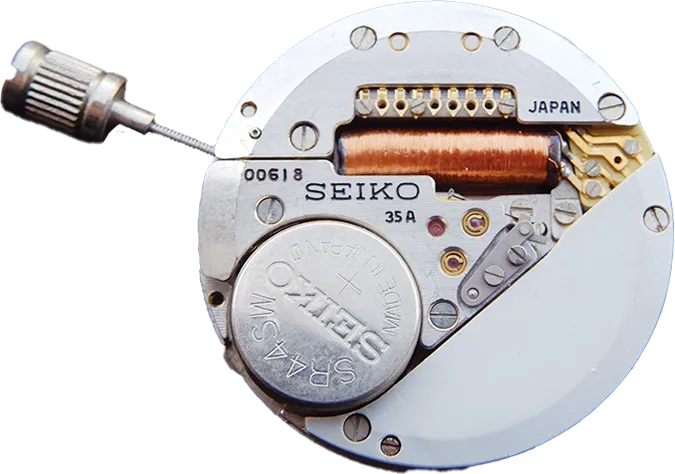 The Calibre 35A quartz movement. Its crystal oscillator, electronics and stepper motor fitted inside a unit 30 millimetres wide and 5.3 millimetres thick. Image: Seiko.
The one-year deadline
Seiko was not working alone. American, French and Swiss companies were all looking for the next form of the electric wristwatch. Some drove conventional balances with batteries, Bulova used a tuning fork, and the Swiss CEH research centre was developing its own quartz movement. At the Neuchâtel Observatory trials in 1967, both Suwa Seikosha and CEH entered quartz wristwatch prototypes.
The race was closer than the word “first” tends to suggest.
In 1968, company president Shoji Hattori reviewed the progress, stopped the tuning-fork programme that had been running in parallel, and gave the quartz team one year to reach the market. Tsuneya Nakamura’s engineers no longer needed merely to produce a working laboratory object. They needed a watch that could be assembled, cased, handed to a customer, and expected to keep running.
Twenty completed watches were ready by December 1969. The name Astron was chosen to echo the language of the space age. Kazunari Sasaki designed the exterior: a broad, slightly angular 36-millimetre gold case, thin hands and restrained hour markers. Some versions did not carry the Astron name on the dial because the trademark had only been registered in Japan.
It was a technical revolution dressed as a luxury watch. There was hardly any other way to charge the price of a car for it.
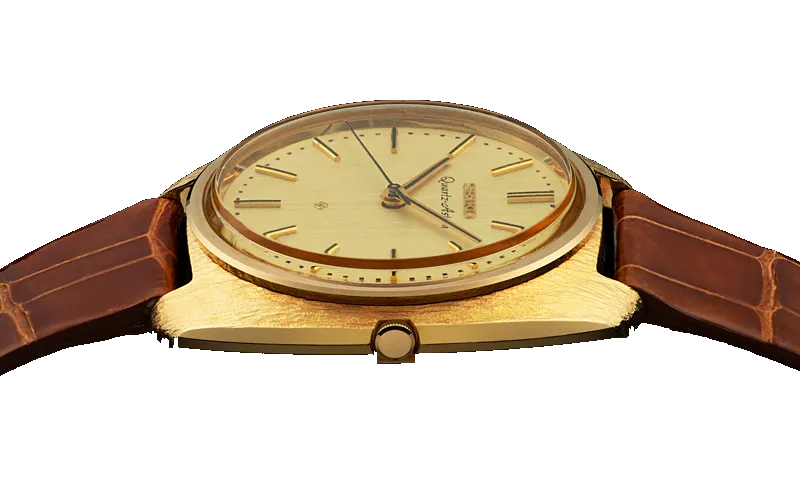 The hand-textured 18-carat gold case. Despite the electronic movement inside, the Astron was presented as a traditional luxury watch. Photo: Seiko Watch Design; background extraction: Lume.
What 450,000 yen bought
The 35SQ crystal oscillated at 8,192 hertz. The movement was rated to approximately 0.2 seconds per day and five seconds per month. A good mechanical wristwatch of the period could lose or gain that much in a single day.
The Astron offered no chronograph, date or alarm. Even its battery life was only about a year. The only visible novelty was the step of its seconds hand. Yet that plain, once-per-second motion would become the easiest way to recognise a quartz watch.
Accounts of the first production run use different numbers. The Smithsonian describes an initial run of about one hundred, while Seiko’s detailed history says that twenty watches had been completed by December 1969. Those claims need not contradict each other. One can refer to the opening production batch and the other to the pieces ready at the exact moment of launch.
There is no dispute that this was not an instant watch for everyone. It was too expensive and too difficult to manufacture. The Astron’s first task was not to appear on every wrist. It proved that quartz could fit inside a wristwatch and survive as a product someone could actually buy.
On January 5, 1970, The New York Times reported on it. The new Japanese watch was news not because it was an attractive gold object, but because it offered a level of accuracy that had never belonged to an ordinary wristwatch.
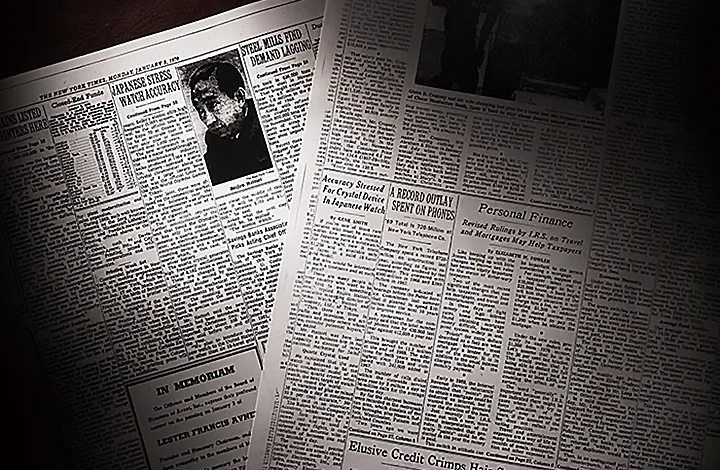 The January 5, 1970 issue of The New York Times reporting on the new Japanese quartz watch. Image: Seiko archive.
The patents were not simply “given away”
The Astron story is often followed by a neat claim: Seiko opened all its quartz patents for free, and that is why the technology spread so quickly. The truth needs a more careful sentence.
Seiko’s own histories state that the company disclosed several key technologies, including patents connected to its tuning-fork-shaped quartz resonator. This did not put a complete set of Astron drawings on every competitor’s desk the following morning. Other companies had their own research, circuitry and manufacturing methods. The Swiss Beta 21, for example, came from an independent development programme.
The important point was that some basic solutions could become industry standards. A tuning-fork quartz crystal, low-power electronics, a motor stepping once per second and conventional analogue hands formed an architecture that could later be made smaller, cheaper and by the million.
The Astron did not invent every part of the modern quartz watch on its own. It demonstrated which technical route could work.
A revolution in Japan, a crisis in Switzerland
In 1970, Seiko decided to begin mass production of quartz watches. A version with a calendar arrived in 1971, a women’s quartz watch in 1972, and a six-digit LCD model in 1973. By 1982, quartz watches accounted for more than half of global watch production.
The same period acquired two different names. From Japan and from the buyer’s point of view, it was the quartz revolution. For the Swiss industry, it was the quartz crisis.
The mechanical watch lost the property on which the industry had been built for centuries. It was no longer the most accurate form of portable timekeeping. Quartz soon became not only more precise, but vastly cheaper. According to the Federation of the Swiss Watch Industry, employment in the sector fell from roughly 90,000 people in 1970 to just over 30,000 in 1984.
One Seiko did not cause all of that, and neither did quartz alone. Economic crises, exchange rates, overproduction and an industry structure that struggled to adapt all played their part. The Astron remains the object at which the change first moved from a display case to a shop counter.
What it really changed
Quartz did not kill the mechanical watch. It took away its monopoly on precision and forced it into a new role.
Anyone who simply wanted to know the correct time no longer needed a balance wheel, hand regulation and expensive watchmaking labour. The mechanical watch gradually came to mean something else: craft, visible machinery, tradition and luxury. Quartz quietly turned accuracy into a utility.
That is the strangest part of the 1969 Astron. A watch made of 18-carat gold and priced like a car opened the way for the cheapest, most accurate mass-produced watches ever made.
It was not itself a democratic product. It merely proved that democracy was technically possible.