LUME
An independent watch journal Watches. Up close.
EST. MMXXVI LUME Local time

Interactive movements

Inside the watch.

Working models made for the Friday Movement pieces. Start them, slow them down, switch things off — and see what the machinery beneath the dial actually does.

12 working models The model loads only when you start it.

When the blade snaps

Start with one elastic part. Then follow energy through the watch. Two experiments with separate, stated assumptions.

Read the full piece →
LUME WORKSHOP / CONSTANT ESCAPEMENT

When the blade snaps

Start with one elastic part. Then follow energy through the watch. Two experiments with separate, stated assumptions.

Open full workshop ↗
Find it in the watch
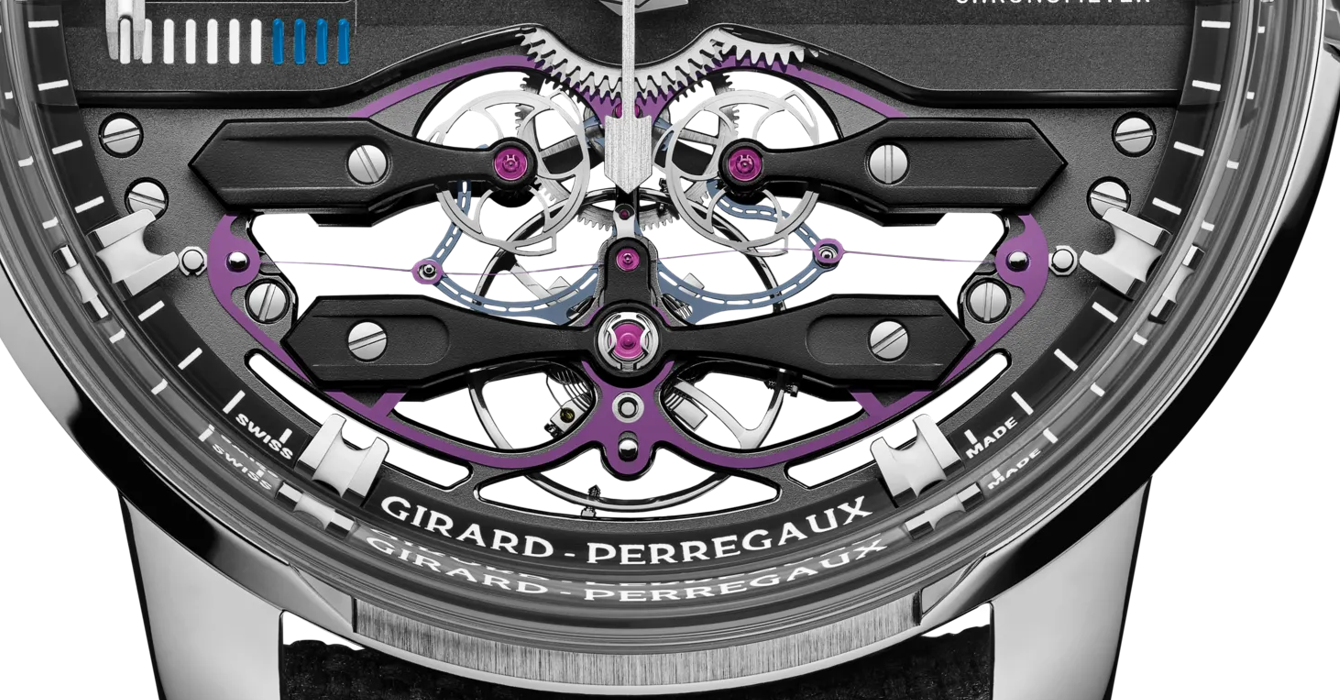
An original Neo Constant Escapement detail showing the purple frame, fine blade and balance beneath the lower bridge.
Photo: Girard-Perregaux, detail from the original 93510-21-1930-5CX front view.

The blade runs approximately horizontally inside the purple frame. The balance is visible behind the lowest black bridge. Central connections give the production blade a wave-like shape. The simpler beam below makes its change of stability easier to follow.

01 / 05

One blade, two places to rest

The fixed ends impose a small compression. The strip can rest bowed towards either side. The coloured ribbon is an enlarged principle beam, not the complete production silicon assembly.

Drag the drawing to rotate the view.

Blade shape q+1.00
Potential energy0.00
Principle threshold±0.385
Ready to startModel time 0.00

External loading increases and reverses automatically. The physical model still calculates the blade motion.

Potential energy
−1.60+1.6

Shape / q · Relative energy

All values are relative. No µJ or measured microseconds.

What is calculated?

Blade mode is a damped single-coordinate mechanical approximation. The spatial ribbon visualises that coordinate. It is neither a finite-element material model nor scale CAD of the GP09200. Energy-metering mode is a separate teaching state machine. Numbers from the two experiments cannot be interchanged. Six half-oscillations per second is a manufacturer specification. The teaching rhythm here is deliberately slower.

Beam model: U(q) = (q² − 1)² / 4. Motion: q″ + 0.45q′ + q(q² − 1) = F. RK4 integration with steps no larger than 1/240. The separate metering model assumes unit doses and keeps its own energy balance.
Understand the tourbillon

Start with what makes a watch tick. Then rotate its regulator, follow the energy supply and explore what rotation can actually change.

Read the full piece →
LUME / WORKSHOP

Understand the tourbillon

Start with what makes a watch tick. Then rotate its regulator, follow the energy supply and explore what rotation can actually change.

Open the large Workshop view

01 / 05

The balance swings; the spring returns it

The large wheel turns back and forth rather than continuously around. The fine spiral is the hairspring. Together they establish the watch’s repeating rhythm.

Enlarged plan viewStationary minute scale

In 1 minute: 1 carriage turn · 240 oscillations · 480 half-oscillations

Motion paused.

What did we simplify?

An original teaching diagram, not a dismantlable digital replica of a specific watch. Components, teeth and layers are not to scale. Spring deformation, lever action and escape-wheel steps are indicative, not a dynamics, friction or contact simulation. Rate data are assumed, not measured.

Rate-example formula

r = b + 3 cos²α + A sin²α cos(β + φ)

α is the angle between the carriage axis and gravity; β is case azimuth; φ is carriage angle. Rotation does not remove the separate horizontal term. Curves are averaged over elapsed time.

Two paths to the balance

Follow one complete Co-Axial oscillation. Inspect the large wheel, the smaller impulse wheel and the lever separately.

Read the full piece →
LUME / Workshop / Co-Axial

Two paths to the balance

Follow one complete Co-Axial oscillation. Inspect the large wheel, the smaller impulse wheel and the lever separately.

Escape wheelLocked01 / 08
Oscillation phases

Exit-pallet lock

The mainspring loads the train, but the exit pallet arrests the escape wheel. The balance approaches the engagement region.

Energy path

No maintaining impulse. Locking restrains the train while the balance and hairspring exchange energy. Unlocking also draws energy from the oscillator to move the lever.

Numbers identify the components. Both wheel levels rotate as one rigid assembly; the balance has its own, separate axis.

What changes from the Swiss lever?

A Swiss lever delivers both impulses through the lever as a tooth slides along an impulse face. The Co-Axial separates locking from impulse and uses direct transmission in one direction. Short contact does not mean zero friction.

Teaching model based on the principle of Daniels patent EP0018796. Tooth profiles, clearances, angles and phase durations are illustrative, not manufacturing geometry or a contact simulation. The hairspring is symbolic. Coloured lines indicate energy paths, not components. Safety roller and banking details are omitted. Here 1× means a 12-second teaching cycle, not the real running speed of a watch.

Exit-pallet lock

Two finishers, one stopwatch

Hold one hand while the other keeps timing. Beside the dial, see the mechanism that retains the intermediate time.

Read the full piece →
LUME / Workshop

Two finishers, one stopwatch

Hold one hand while the other keeps timing. Beside the dial, see the mechanism that retains the intermediate time.

01 / What you read

ChronographSplit-seconds hand

02 / What happens inside

Heart cam and followerTwo-sided brake
Elapsed time0.0 s
Split hand0.0 s
Difference0.0 s

Start the timer or advance it by hand. Both hands are aligned.

The first finisher arrives at 12 seconds, the second at 18. The difference is 6 seconds. Use Catch up to align the hands, then start a new measurement.

What do the moving parts represent?
  1. The inner heart cam turns with the chronograph. A spring-loaded follower transmits its motion to the split-seconds wheel.
  2. For a split reading, the outer jaws grip the split wheel. The follower lifts away from the still-rotating cam, illustrating the isolator’s function.
  3. On release, the clamp opens and the follower returns to the cam, aligning the hands. Real rejoining is rapid; this model shows the resulting position.

An educational model with one pair of seconds hands, not a scale replica of L001.1. The minute counter, flyback, column wheel and isolator control parts are omitted. Cam profile and lever travel are illustrative. No friction or rate accuracy is simulated. No autoplay; manual stepping is available.

Jumping seconds

Compare the continuous internal rhythm with a hand that advances once per second. Slow down, step through and explore the relationship between the star and flirt.

Read the full piece →

Six steps inside. One outside.

Play, slow down, or advance one half-oscillation at a time. Both hands display the same time with different rhythms.

BalanceThe internal timebase keeps working.
Conventional handOne small step per half-oscillation.
Jumping handOne marker per whole second.
Model time
0.000 s
Half-oscillations
0
Jumps
0

An original functional illustration, not a scale reconstruction of a calibre. The separate star-and-flirt view follows Lange’s description; the release motion is extended for visibility. The remontoir, complete gearing and physical arrangement of components are not represented.

06 Intermediate 11 Sept 2026

The minute repeater at work

Set a time, then hear and follow how hours become low notes, quarters become pairs, and the remaining minutes become high notes.

Read the full piece
The two hammers of a Patek Philippe minute repeater

The model loads only when you start it.

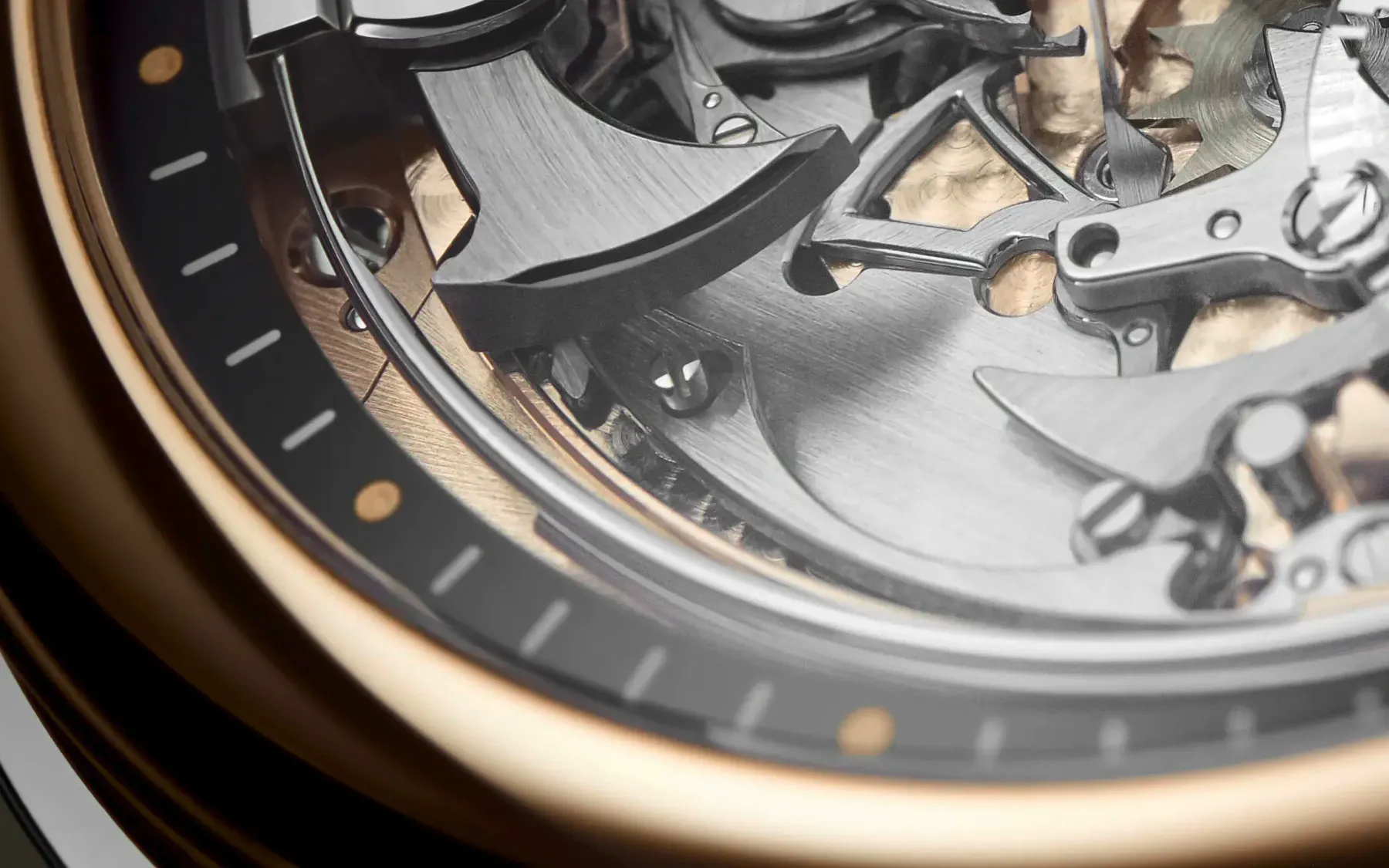
The two polished hammers are visible on the left of the dial. Only slender arcs of the surrounding gongs can be seen, yet they produce the watch's two voices. Photograph: Patek Philippe .

07 Foundations 4 Sept 2026

The rotor in motion

Move the watch and follow the energy from the rotor through the reverser and gear train into the mainspring.

Read the full piece
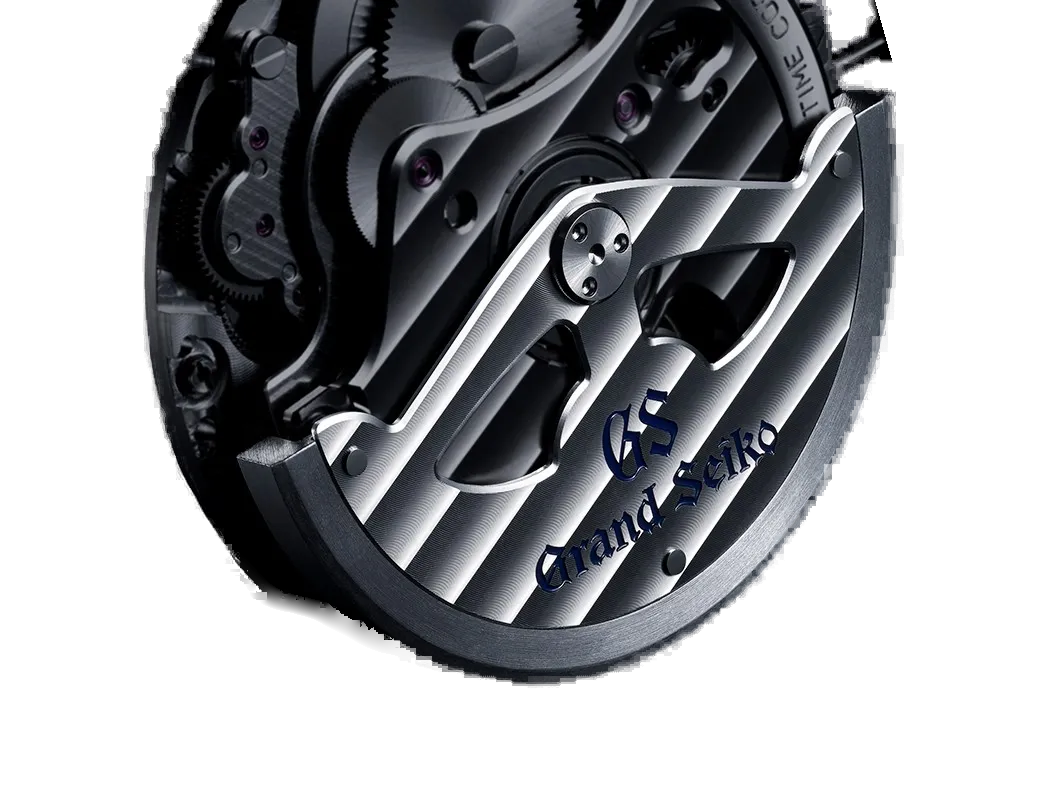
The semicircular rotor of a Grand Seiko automatic movement

The model loads only when you start it.

Mass is concentrated along the rotor's outer arc, allowing it to turn relative to the movement even when the case moves only slightly. Photo: Grand Seiko , background removed.

08 Foundations 28 Aug 2026

What happens when a G-Shock hits the ground?

Drop the same watch with rigid and cushioned internal mounting, then compare how much of the load reaches the module.

Read the full piece
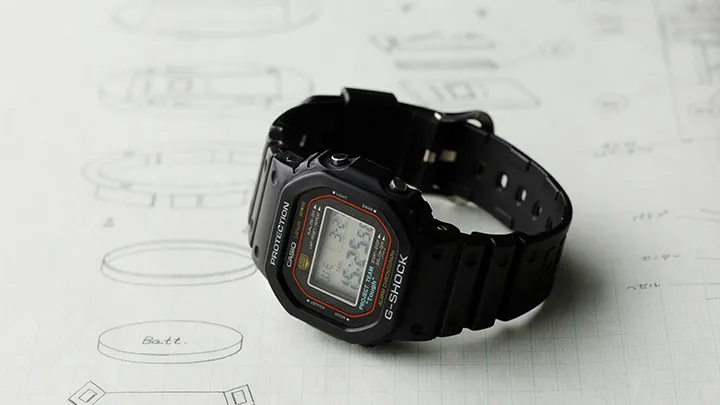
A classic square G-Shock resting on an early technical drawing

The model loads only when you start it.

The classic square G-Shock form resting on an early technical drawing. Photo: Casio .

09 Intermediate 21 Aug 2026

The world timer in motion

Choose a city and see how the city ring and the twenty-four-hour day–night disc turn into position.

Read the full piece
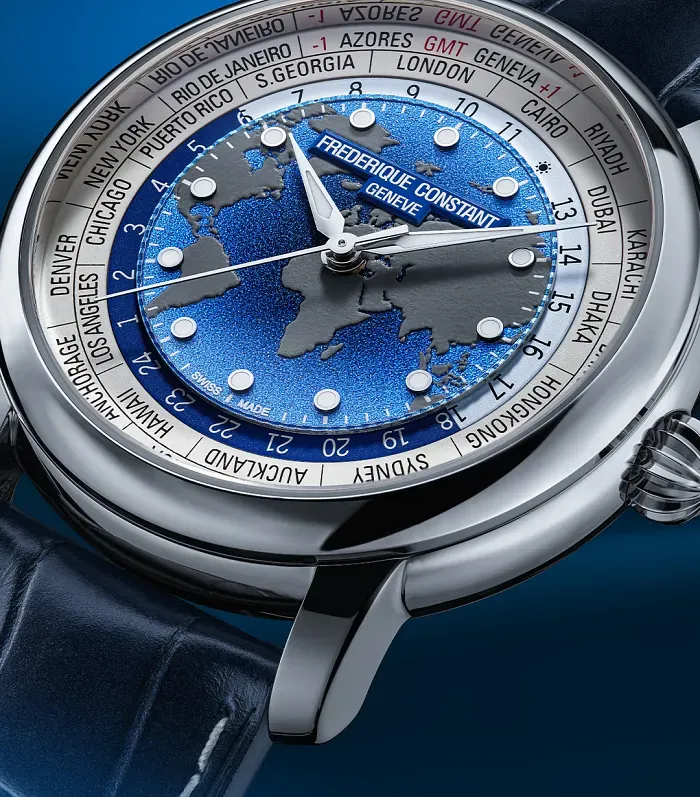
The Worldtimer dial up close

The model loads only when you start it.

The twenty-four city names, the day and night disc, and the engraved world map. Photo: Frederique Constant (frederiqueconstant.com).

11 Intermediate 7 Aug 2026

Spring Drive in motion

Follow the energy from the mainspring to the glide wheel, then disable regulation to see what the Tri-Synchro Regulator actually does.

Read the full piece
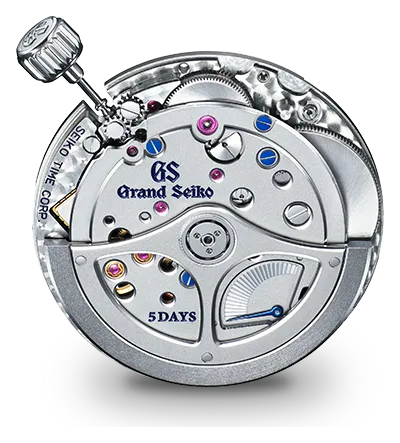
The Grand Seiko 9R Spring Drive caliber, with a silver plate and blued screws

The model loads only when you start it.

The 9R Spring Drive caliber: at the end of the gear train, the glide wheel, in place of an escapement. Photo: Grand Seiko (grand-seiko.com)

12 Intermediate 30 Jul 2026

The column wheel in motion

Start the chronograph and watch a single wheel coordinate its levers in one precise sequence.

Read the full piece
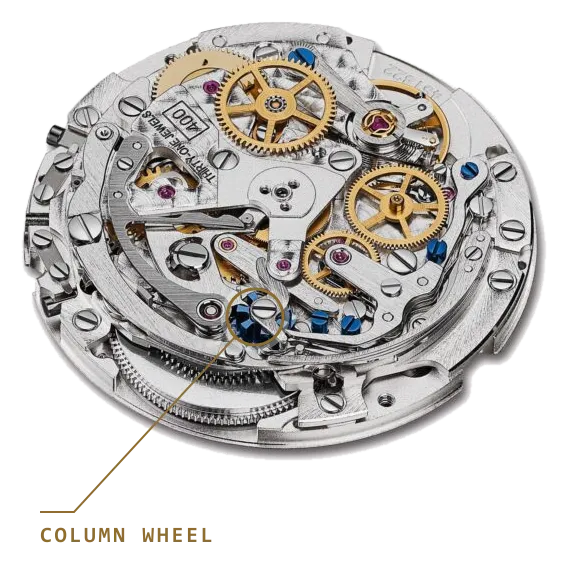
The Zenith El Primero calibre 400 with the column wheel marked: a ring of blued steel pillars around a retaining screw

The model loads only when you start it.

The Zenith El Primero calibre 400. The coupling lever's beak rests on the ring of pillars from the right. Highlight added by Lume. Photo: Monochrome Watches (monochrome-watches.com)

Search the journal

Take a closer look.