Last Friday, September 11, 2026, marked the twenty-fifth anniversary of the 2001 terrorist attacks. That anniversary prompted this article. Through Todd Beamer’s watch, we want to remember him and the victims of Flight 93: by looking at a personal possession originally meant for the working days ahead.
A date window is usually one of the least remarkable parts of a dial. When it works, we barely notice it: a small number in the routine of the next appointment, the next working day. On Todd Beamer’s Rolex, that number is eleven.
The New York 9/11 Memorial & Museum draws attention to this detail. Reading the time from the watch would be another matter. Its case is distorted, its dial damaged, its once orderly surfaces disrupted. The brand remains recognisable. Its owner’s name has become more important.
A watch story usually asks how an object was made and why it works the way it does. This one asks why we preserve a watch when telling the time is no longer the reason to look at it.
The name beside the dial
Beamer was 32, an Oracle account manager living in Cranbury, New Jersey. His wife, Lisa, was expecting their third child. On September 11, 2001, he set out on a business trip to California. These are the brief, ordinary details in the museum’s biographical record. Behind them was a life whose continuation he and his family could take for granted.
Beamer’s name also appears among those inscribed at New York’s September 11 memorial. The inscription does not recount that ordinary life; it names the person who was lost. That is a useful starting point for looking at the watch too: a memorial object can easily obscure the person it is meant to help us remember.
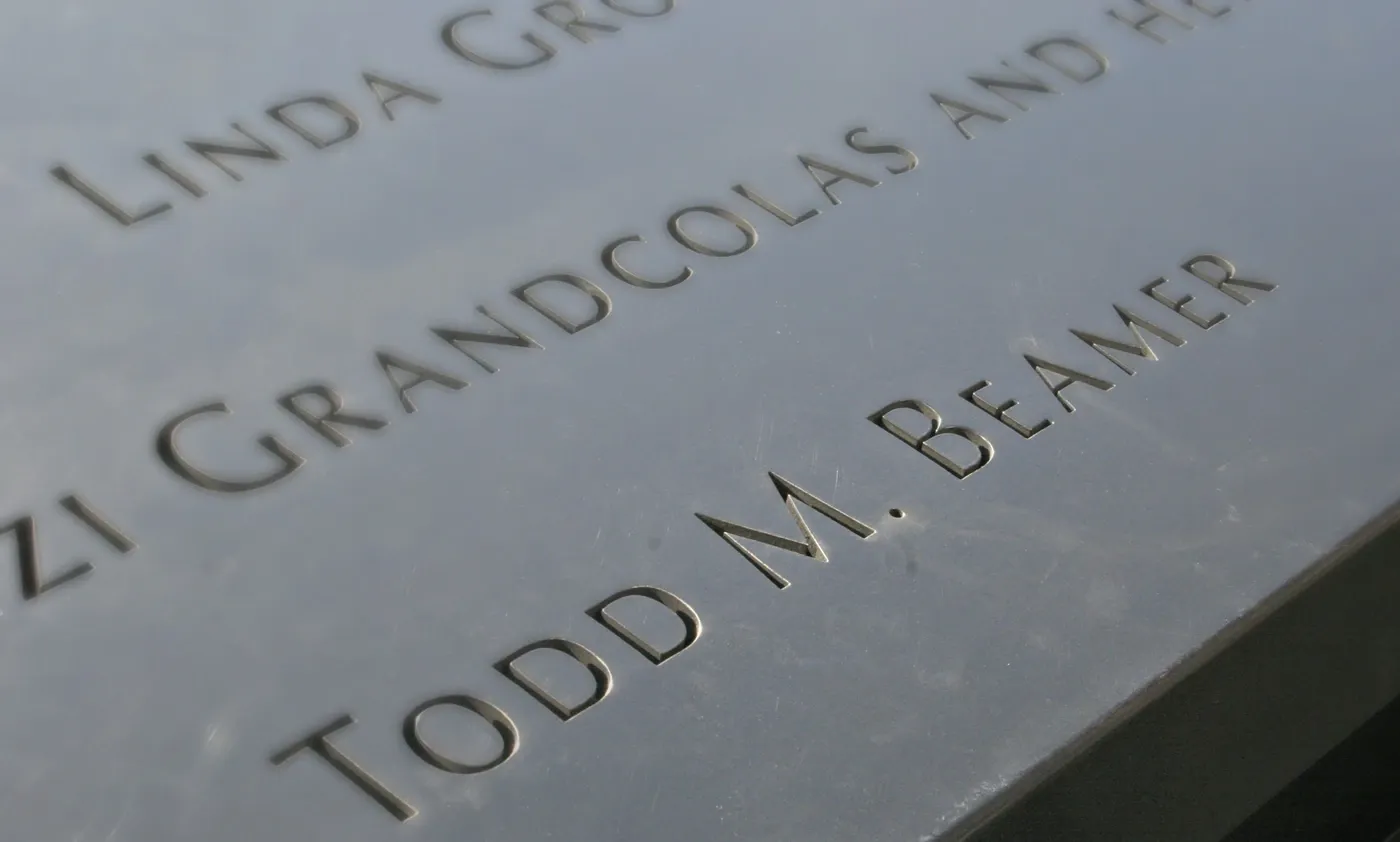
Todd M. Beamer’s name at the New York memorial, March 9, 2014. Photograph: Brian Soergel, Todd Beamer WTC / Wikimedia Commons, CC BY-SA 3.0. Resized and converted to WebP; the inscription is unchanged.

The museum also holds a recovered Oracle business card. It is creased and missing a corner, but his name and job title remain legible. The catalogue records it as a gift of the Beamer family. Together, the card and the watch mark the point at which things carried to work become historical objects. Neither was made for that purpose.
Which Rolex was it?
The words “Oyster Perpetual” alone do not identify the model. Several histories overlap in Rolex’s naming system: Oyster refers to the sealed case, Perpetual to automatic winding. Both terms can also appear in the Datejust’s name and on its dial.
Hodinkee’s 2024 account identifies Beamer’s watch as a two-tone Datejust Turn-O-Graph with a finely striped tapestry dial. We follow that identification. We do not assign an exact reference number: the museum material checked for this article did not establish one. A catalogue entry for a similar watch cannot substitute for the documentation of this particular object.
We illustrate the model here with a separate, intact watch, not a photograph of the museum object. This example’s Roman-numeral dial differs from Beamer’s striped dial, but its date window, graduated bezel and two-tone bracelet are clearly visible. The comparison explains the design; it is not a reconstruction of Beamer’s watch before it was damaged.

Model illustration, not Beamer’s watch. The photographer describes this as a 1992 Datejust Turn-O-Graph. Photograph: Norbert Pietsch (Enpi48) / Wikimedia Commons, CC BY-SA 4.0. Lume: background removal using an AI matte, preserving the original watch pixels; the cutout is also CC BY-SA 4.0. The original photograph displays eight in the date window; we have not changed it to eleven.

Three names, three functions
Rolex’s own history dates the Oyster to 1926, the Perpetual rotor to 1931 and the Datejust to 1945. The case protects the movement, the rotor uses the wearer’s motion to wind it, and the date window shows the day of the month. Perpetual here means automatic winding, not a perpetual calendar.
The Turn-O-Graph’s distinction is on the outside: the ring surrounding the dial, the bezel, rotates and carries a timing scale. A decorative bezel primarily gives a watch shape and reflections. Here, the same component becomes a simple timing aid. It gives the Turn-O-Graph a character of its own within the Datejust family, combining an elegant appearance with a function operated directly by hand.
From sporting origins to the Datejust
The Turn-O-Graph story begins in 1953 with reference 6202. The early example documented by Phillips has a black lacquer dial and a rotating bezel graduated in sixty units. The idea is already present: a movable scale around the dial gives a conventional three-hand watch another task, without a separate stopwatch mechanism.
By the mid-1950s, that idea had appeared on the Datejust. Phillips dates its reference 6309 example to 1955; it combines a date window with a numbered rotating bezel. This was more than a change of name. The timing ring had moved into the Datejust’s different, everyday setting.
The Thunderbird name belongs to this period too. Phillips traces the nickname to early American advertising featuring the US Air Force Thunderbirds demonstration team. It is part of the model’s history, not evidence that Beamer’s watch had military provenance or was a special edition.
That duality makes the model interesting. Gold details and a textured dial can draw attention to its dressier side, while the ring around the dial preserves an early practical idea. The Turn-O-Graph does not express its sporting function through additional subdials or pushers. It keeps it within a familiar watch silhouette.
What does the rotating ring do?
Consider an ordinary example. The minute hand is at the twenty-minute mark when we turn the bezel and align its starting marker with the hand. When the hand later reaches the thirty-five-minute mark, the ring shows fifteen elapsed minutes. The dial still displays the time of day; the ring has simply supplied a second point of reference.
This is not a chronograph. No separate timing hand starts, and there is no reset pusher. It is a convenient way to follow the length of a meeting or a short wait, but the ring does not count elapsed hours for us: after sixty minutes, the minute hand completes another revolution. The appeal is its simplicity. The bezel’s position remembers when the measurement began.
A Christie’s lot dated to around 1996 provides a specific example of a later Datejust Turn-O-Graph: steel and 18-carat gold, a Jubilee bracelet and automatic calibre 3135. Its condition report also records a quick-set date function. These are the documented specifications of that example, not verified specifications for Beamer’s damaged watch.
Quick-set means the date can be advanced independently, without repeatedly winding the hour and minute hands around the dial. If an automatic watch has stopped while unworn, that makes a practical difference when setting it again. The rotor, date and rotating ring perform three separate jobs: supplying energy, providing a calendar reference and helping the wearer track short intervals.
This technical detour helps explain what the watch was designed to do. It tells us nothing about how Beamer used it during his final minutes. We have no verified evidence that he timed the resistance with its bezel, or even that he consulted the watch. We cannot give it that role retrospectively because it would make a compelling watch story.
The limits of a telephone account
According to the National Park Service’s call summary, Beamer spoke to a GTE operator through an Airfone seatback telephone. Attempts to reach his wife failed; he entrusted a message for her to the operator. The conversation also conveyed that passengers were preparing to act.
The “Let’s roll” phrase associated with him comes from the operator’s account. We are not quoting an authenticated, publicly available recording of Beamer saying it. The NPS distinguishes recorded messages from witness recollections; that distinction matters when reading the account.
A brief phrase is easier to retain in collective memory than an entire sequence of events. Beamer’s name consequently became a symbol of resistance. The symbol should not reduce the story to a single person. Other passengers and crew members also made calls, relayed information and took part in the collective action.
What we know about 10:03
The 9/11 Commission Report places the beginning of the passenger counterattack at 9:57. The hijackers remained at the controls during the struggle and ultimately drove the aircraft into the ground. Flight 93 crashed near Shanksville, Pennsylvania, at 10:03 local time. It did not reach its intended target in Washington.
The report supports the impact time with evidence including radar data and the aircraft’s recorders. The position of the watch’s damaged hands cannot independently establish it. Force can displace hands, and a photograph alone does not reveal when a movement stopped.
Making that distinction does not diminish the watch’s significance. It places it more accurately. The investigation provides the evidence for the flight’s final moments; the eleven visible in the date window belongs to the personal dimension of remembrance.
Preserving a watch, rather than running it
A damaged watch can readily turn a collector’s thoughts towards repair. Could a new crystal be fitted? Could the dial be replaced? Might it run after a full service? Those questions lead away from the subject here. We are not conducting a condition assessment, and we have no verified information about the movement’s ability to function.
It is more useful to consider how the object’s purpose has changed. As a working watch, it was meant to leave yesterday behind and show the following day. As an object of remembrance, it connects us to one particular day. Its damage is therefore more than a cosmetic flaw: it is part of what the object communicates. This is our reading of its significance, not a claim about any specific conservation treatment undertaken by the museum.
The Flight 93 National Memorial honours the flight’s forty passengers and crew members. Alongside those forty names, Beamer’s watch brings us closer to one life. It reminds us that the people in historical accounts had working days, families and familiar personal possessions.
Gold, steel and an automatic movement explain what kind of watch it was. Todd Beamer’s name explains why we remember it. Eleven remains in the date window.