The crown of the Heuer Monaco sat on the left side of its case. Not because a designer found it more attractive there, and not because the watch was intended for left-handed customers. It was the only sensible way to assemble the movement.
The watch appeared in March 1969. It was square in a world of round watches, blue in an industry accustomed to black and white dials, and thick at a time when elegance meant thinness. Inside was an automatic chronograph, so the Monaco was trying to solve an engineering problem while selling a shape previously considered almost impossible for a water-resistant sports watch.
It was not a success.
After roughly six years, Monaco vanished from Heuer’s regular catalogue. Had Steve McQueen not worn one on a film set, it might now receive the same quick glance as many other strange chronographs from the period.
Its history is not the comfortable story in which the world recognises a brilliant design at once. It is the story of a commercial failure transformed into an icon decades later by a film, a set of archive photographs and the nostalgia of the 1990s.
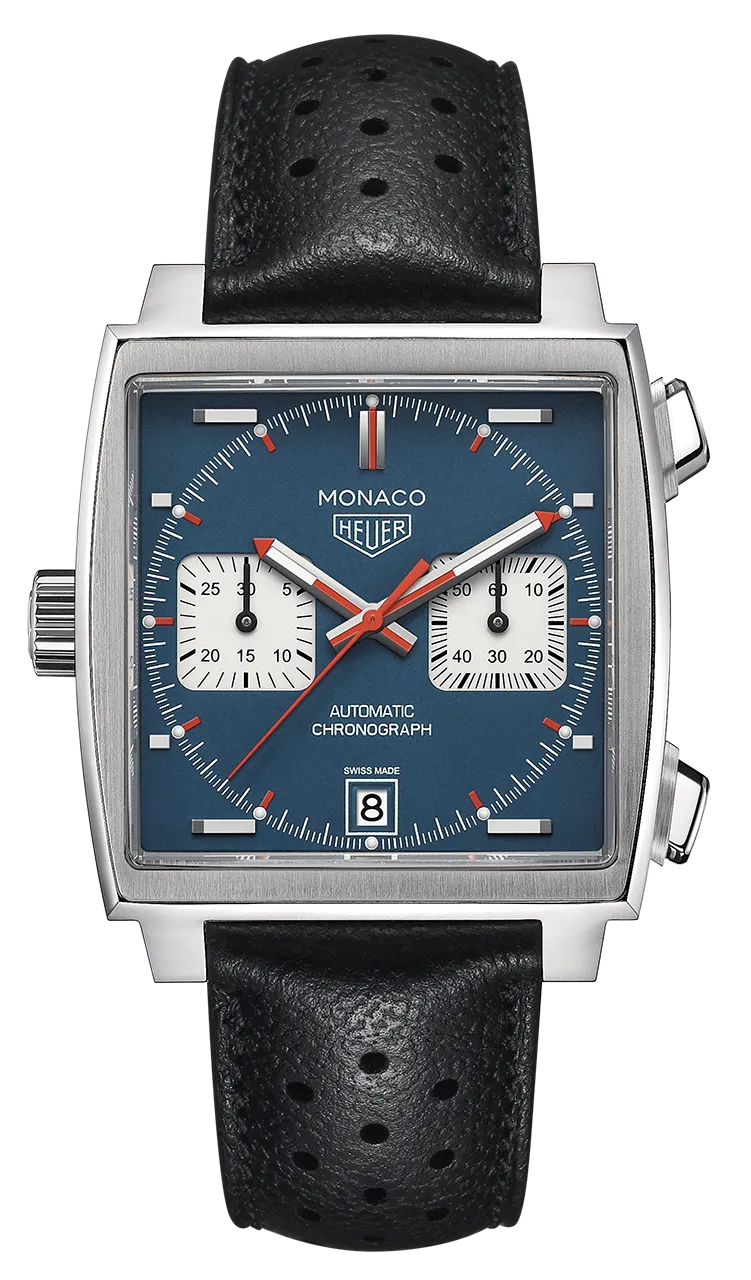 The modern Monaco Calibre 11 carries the crown on the left. Photo: TAG Heuer.
The race in which everybody has a different first place
By the middle of the 1960s, automatic wristwatches were ordinary technology. Chronographs still required hand winding. Combining the two was difficult because the stopwatch controls, wheels and counters occupied a great deal of space, while an oscillating weight also needed room to move.
Three development programmes ran at once.
Zenith announced El Primero on 10 January 1969, a high-frequency, fully integrated automatic chronograph. Seiko released the 6139 in Japan during the same year, using a column wheel and vertical clutch. The third effort was not a single manufacture, but an alliance of rivals.
Heuer-Leonidas and Breitling made chronographs. Büren, by then owned by Hamilton, specialised in thin micro-rotor automatic movements. Dubois Dépraz took responsibility for the chronograph module. Their secret collaboration was called Project 99.
They did not design a single integrated calibre from the ground up. Instead, a separate Dubois Dépraz stopwatch module was attached to a Büren automatic base movement. The module sat on the dial side, leaving the controls of the two assemblies on opposite sides. The chronograph pushers remained on the right. The crown moved to the left.
The result was Calibre 11, also called Chronomatic. It was presented simultaneously in Geneva and New York on 3 March 1969.
Which was the world’s first automatic chronograph depends on the measurement. Zenith announced first. The Project 99 group showed several working watch models in spring and supplied international markets later that year. Seiko’s 6139 appears to have reached early customers in Japan quickly. Each side can write a factually defensible sentence in which it comes first.
The more important point is that an old engineering problem received three substantially different answers in 1969.
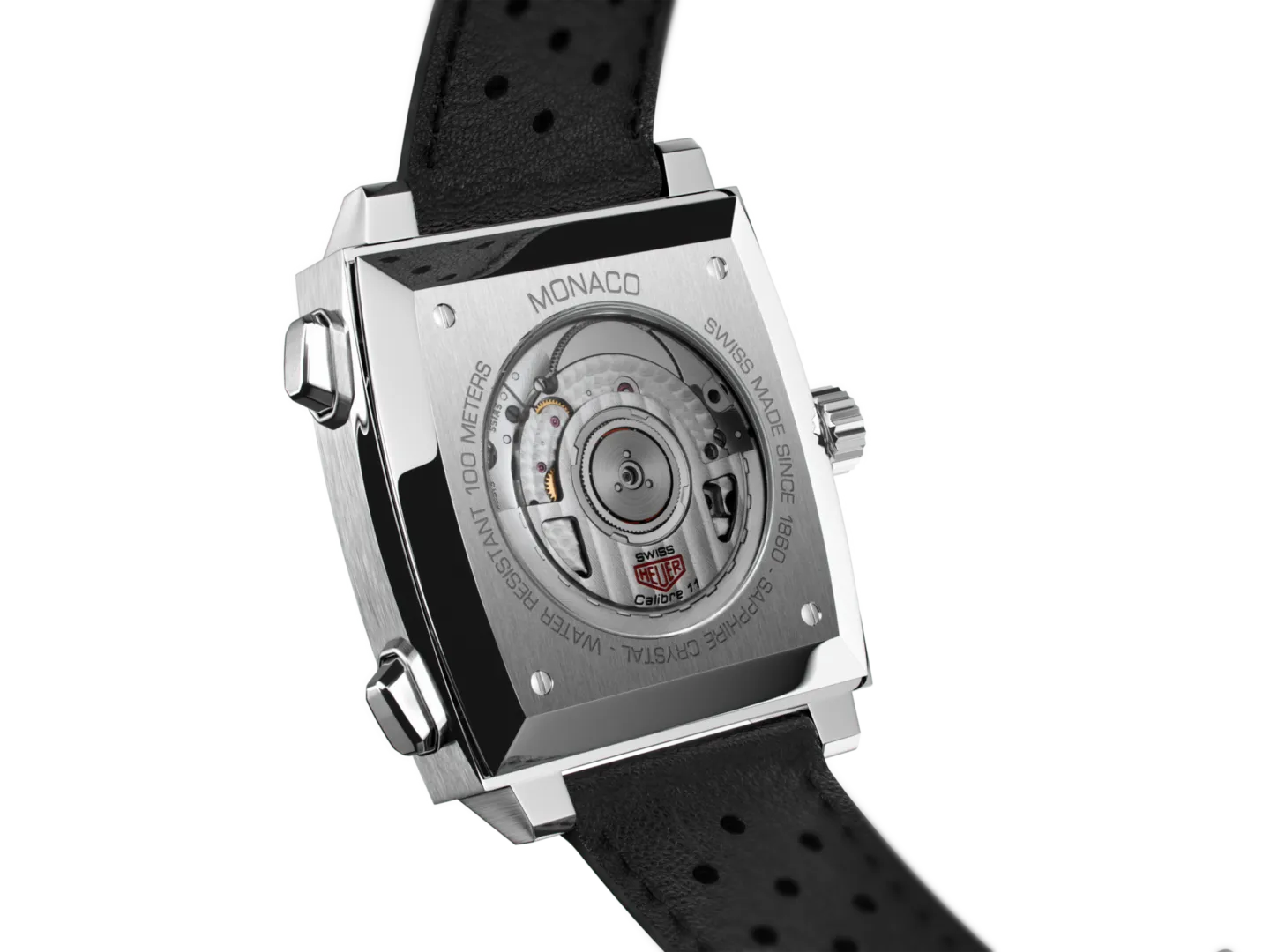 A modern Calibre 11 from the back, showing the rotor and today’s version of the modular architecture. Photo: TAG Heuer.
The case Heuer had to keep away from Breitling
Jack Heuer intended to install the new movement in the Autavia and Carrera. Both were established round watches that simply needed larger cases for the thicker Calibre 11. Heuer also felt that the new technology deserved a third model, one that announced from across a room that something had changed.
Then a representative of Erwin Piquerez SA arrived with a sample of a square case.
Square watches were not new. A water-resistant square sports case was another matter. Pressure is distributed evenly around a round back and gasket. Sealing corners was more difficult, so contemporary square watches tended to be thin dress pieces.
Piquerez had patented a system that solved the seal. Jack Heuer immediately saw the opportunity and negotiated exclusive use of the case for chronographs. That mattered because Breitling, a partner in Calibre 11, had access to the same movement. They were building an engine together while competing for the same customers. The square case ensured that Heuer’s launch watch could not be confused with its partner’s product.
The name came from the Monaco Grand Prix. Its steel case measured 39 millimetres across, with sharp edges and an unusually tall square acrylic crystal. The blue reference 1133B had white registers, red hands and a date at six. There was also a grey 1133G.
Monaco was both an engineering demonstrator and a colourful object standing at the edge of the 1970s. That was its strength. It became its problem too.
A watch that told you not to touch it
A useful marketing line was later built around the left-side crown. An automatic watch did not need winding every morning, so the crown could be moved to the side where the wearer was less likely to reach it. Heuer made the position a visible signal that the new chronograph wound itself.
The truth was more prosaic: the modular architecture dictated the layout. Good design, however, often begins by refusing to hide a constraint. Monaco did not apologise for its crown being on the wrong side. It turned the mistake into a signature.
Calibre 11 was not perfect. Its initial frequency of 19,800 vibrations per hour, modular construction and micro-rotor produced a complicated, thick movement. The revised Calibre 12 soon followed at 21,600 vibrations per hour. Calibre 15 and manually wound Monaco references arrived later.
Customers still did not rush to buy one. The case looked large and odd, the blue dial was loud, and the price was high. Heuer even replaced the early “Chronomatic” wording with “Automatic Chronograph” because many American customers and sales staff did not understand the new name.
Monaco left the regular catalogue around 1975. A few late variants followed, but the experiment had effectively ended. Autavia and Carrera survived the difficult decade. The model designed expressly for the future did not.
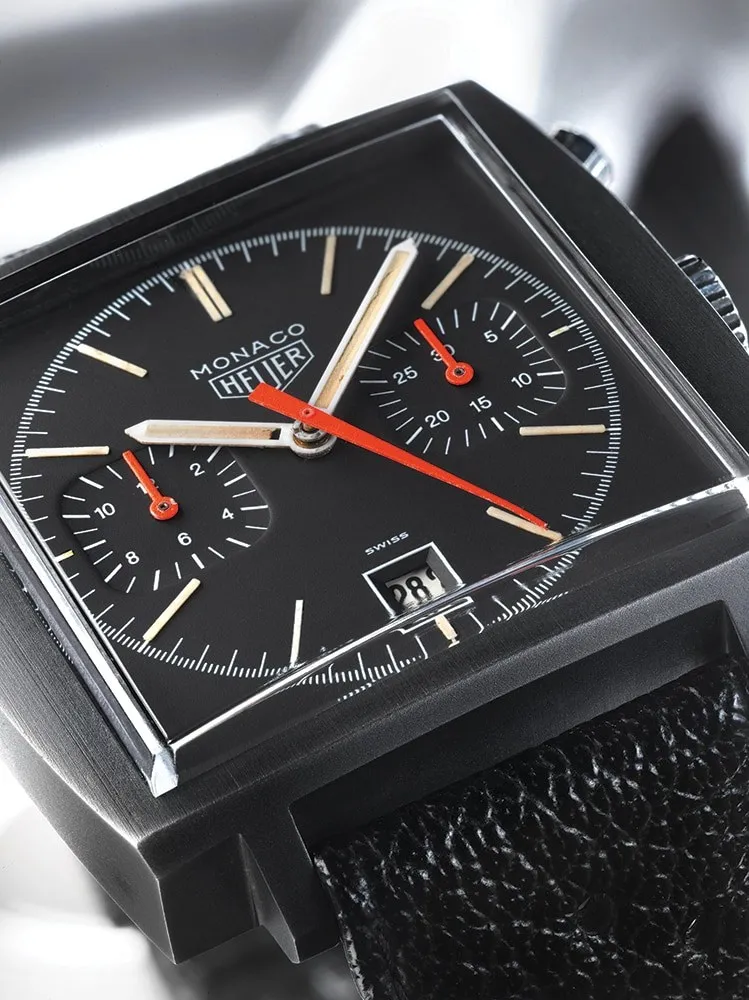 The rare black-coated 74033N, later nicknamed the Dark Lord. Photo: TAG Heuer.
The man who did not want to be an ambassador
Steve McQueen filmed Le Mans in France during the summer of 1970. He did not want a light motor-racing movie. He wanted a racing film in which machines and the circuit mattered more than dialogue. It was completed amid a difficult production, a change of director and financial disorder, then released in 1971.
McQueen’s character, Michael Delaney, needed the appearance of a real driver. The actor modelled him on Swiss racer Jo Siffert, a Heuer ambassador whose racing suit carried the company’s badge. Property master Don Nunley therefore needed a watch that matched the overalls and was available in identical examples for live scenes, still photography and a spare.
According to Jack Heuer’s later account, McQueen was first offered an Omega. He returned it because he did not want the company to use his name in advertising. He chose the blue Heuer Monaco 1133B instead. He could hardly have known that he was creating one of the longest-running unofficial watch campaigns in history.
The film does not stop for a close-up and nobody says the watch’s name. It simply sits on McQueen’s wrist beside the white overalls and Porsche 917. That produced a more credible association than conventional advertising. The watch was not placed on a celebrity. It became part of a character.
This did not save Monaco immediately. By the time Le Mans acquired cult status, the watch was already gone. The value of the McQueen connection was discovered properly by collectors and later reissues.
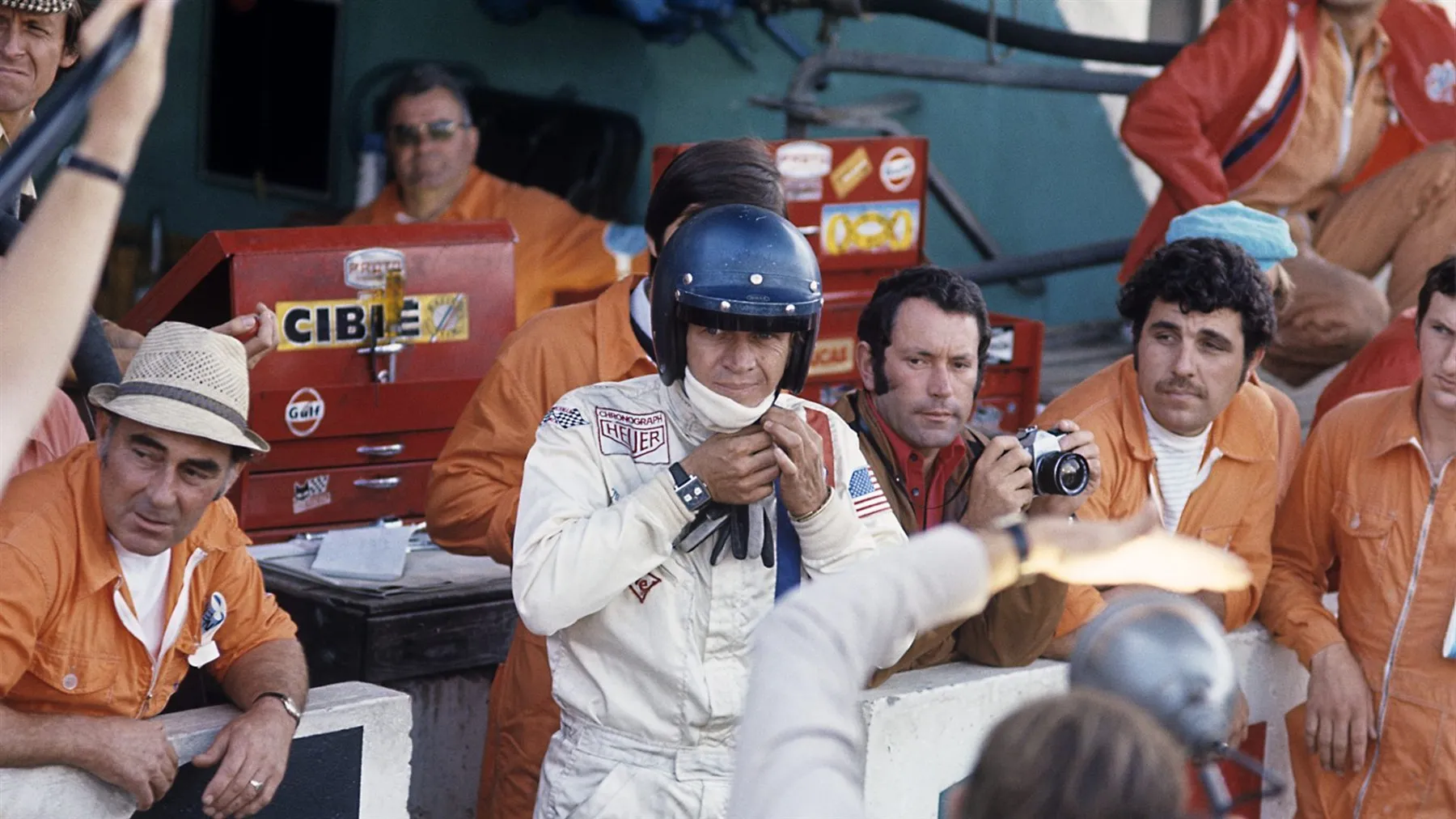 Steve McQueen on the set of Le Mans with the Monaco on his wrist. Photo: Bernard Cahier / Getty Images, TAG Heuer.
Two quiet decades, then a return in black
Heuer changed hands during the quartz crisis and became TAG Heuer after joining the Techniques d’Avant Garde group in 1985. The new brand built Formula 1 models, divers and modern sports watches. For years, the old Heuer catalogue was a closed chapter rather than heritage to be mined.
That changed in the 1990s. After Carrera returned in 1996, the first modern Monaco followed in 1997. Reference CS2110 had a black dial, a manually wound movement and a production run of 5,000. It was not an exact copy of 1133B, though it carried the old Heuer shield on its dial.
The blue McQueen appearance returned later. By then, Monaco was no longer an unsellable curiosity, but evidence of the brand’s history. Failure had created scarcity, film had added meaning, and time had made the shape easier to accept.
Since then, Monaco has appeared with heritage Calibre 11 movements, right-side crowns, skeleton dials, titanium cases, racing colours and numerous limited editions. Not all of them retained the blunt simplicity of the original proportions.
In 2026, TAG Heuer moved back towards the starting point. A new 39-millimetre grade-five titanium case returned closer to the geometry of 1969. TH20-11 is now an integrated, column-wheel manufacture chronograph with an 80-hour power reserve. There is no engineering need for its crown to sit on the left. It remains there anyway.
What was a mechanical constraint in 1969 became heritage by 2026.
What remains without McQueen
It is easy to say that Monaco is famous only because it appeared in a film. Without that film, it certainly would not be the same watch. McQueen could not, however, have made an icon from a completely anonymous object.
Monaco remains awkward. It is thick, presents a large surface, and its corners demand more wrist than a round case of the same width. The dial thinks in circles and squares at once. Pushers sit on the right, the crown on the left. Nothing about it tries to be neutral.
That is why it survived its own failure. Not because it was first in every respect in 1969. The automatic-chronograph title is shared between three programmes, the movement involved compromises, and the market rejected it.
Monaco matters because it did not package new technology in a familiar shape. It accepted that a new movement deserved a new object. Customers did not want that object then. Later, they began to seek precisely the things that had originally made it difficult.
A square case. A blue dial. And a crown on the wrong side.