In this column I usually write about great houses and legendary references. This time, though, the subject is a watch that appears on no list of the best, and that I nonetheless keep returning to.
It is the Frederique Constant Classic Worldtimer. I do not own one, and I have only had the chance to look at it once, in an airport display case. Even so, there are few watches I have read this much about. If you only look at the spec sheet, you will not understand why. If you look at how the brand came about, and at what this watch solved, then perhaps you will.
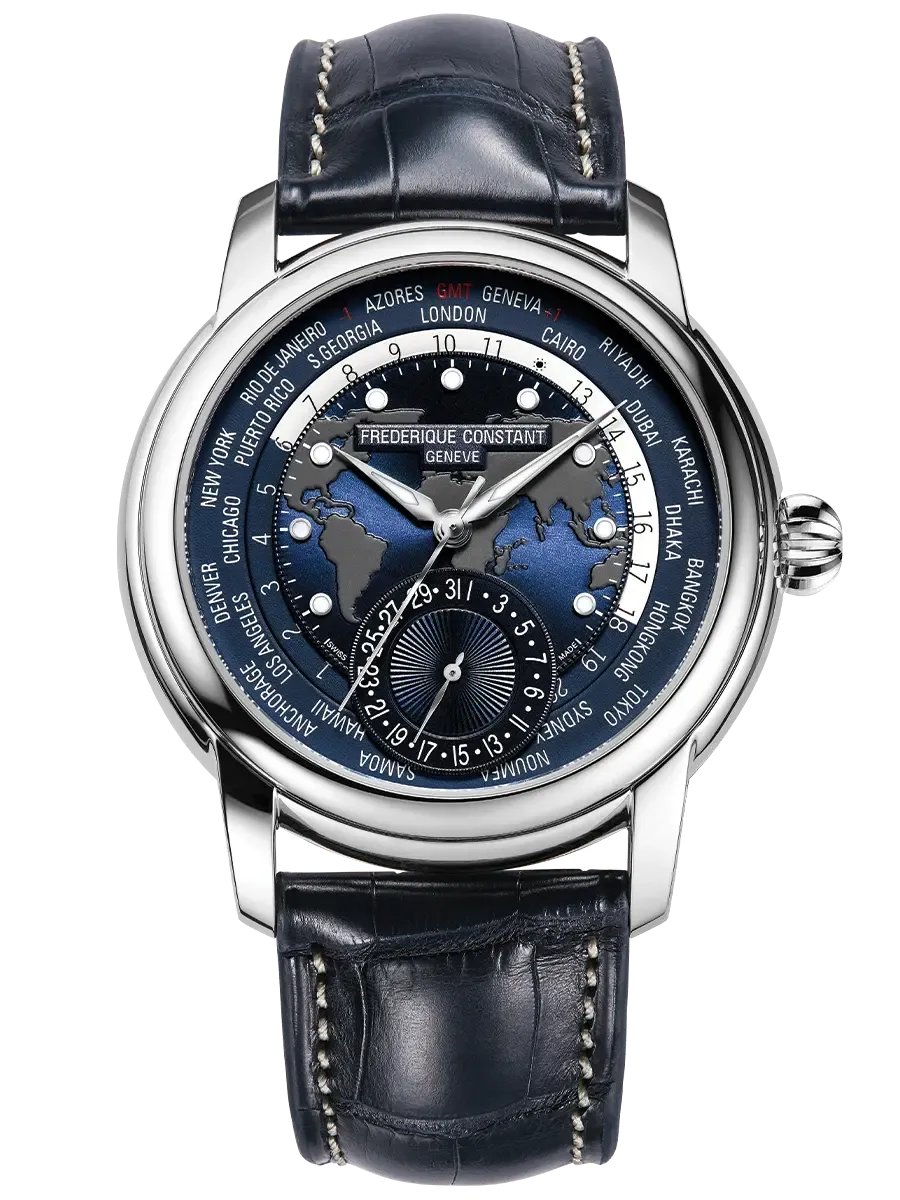 The Classic Worldtimer Manufacture, with the world map at the centre of the dial. Photo: Frederique Constant (frederiqueconstant.com).
Two Dutch people, a skiing holiday, and the worst possible moment
The brand’s backstory is exactly the kind of thing this column exists for.
Peter Stas and Aletta Bax are a Dutch couple. Neither is a watchmaker. Peter studied business economics in Rotterdam and worked at Philips, while Aletta graduated from Leiden. It was during a skiing holiday that they arrived at the conclusion that explains the brand’s entire existence. They noticed that beautiful Swiss watches were unaffordable for young people and keen enthusiasts, while the affordable ones were not even nice to look at. Something was missing in between.
They started the business in 1988, which was one of the worst possible moments for it. The Quartz Crisis was still tearing through the Swiss watch industry, and the mechanical watch had not even begun to come back into fashion. Two Dutch people with no connection to the industry chose precisely that moment to start making Swiss mechanical watches.
The name, though, is the loveliest part of the story. Frederique Constant is assembled from the first names of their great-grandparents: Frederique Schreiner and Constant Stas. These are also their own middle names, since Aletta’s full name is Aletta Francoise Frederique Bax and Peter’s is Peter Constant Stas. And there is an unexpected twist: in 1904 Constant Stas founded a company that made printed watch dials. So the family really did have a connection to watches, four generations earlier.
What they built from it
The first collection appeared in 1992, six models with bought-in Swiss movements, assembled by a watchmaker in Geneva. From there the brand climbed step by step.
The breakthrough came in 1994 with the Heart Beat, which opened a window in the dial so the balance wheel could be seen. That is a common design element across the industry today, but it was not then. Then came the first in-house caliber in 2004, silicon components in 2007, an affordable tourbillon in 2008, and the Worldtimer in 2012.
The brand now operates from Plan-les-Ouates in Geneva, has been part of the Japanese Citizen group since 2016, and has more than thirty calibers of its own. All from the idea of a Dutch couple, worked out on a skiing holiday.
The watch I am actually interested in
And now to what made this piece stay with me.
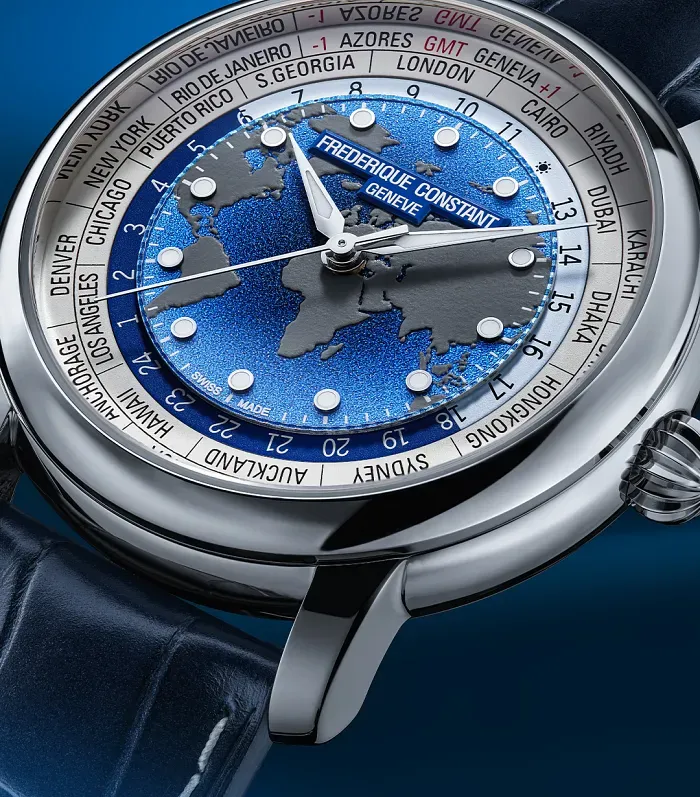
The Classic Worldtimer Manufacture shows twenty-four time zones at once. At the centre of the dial is an engraved world map, around it a twenty-four hour disc, and outside that the names of twenty-four cities. Turn your own city to the twelve o’clock position and from then on the dial shows, all at once, what time it is in every zone on the planet.
There is no separate day and night indicator, because none is needed: one half of the twenty-four hour disc is light, the other dark blue. Where a city name falls on the light section it is daytime, and where it falls on the blue it is night. One glance.
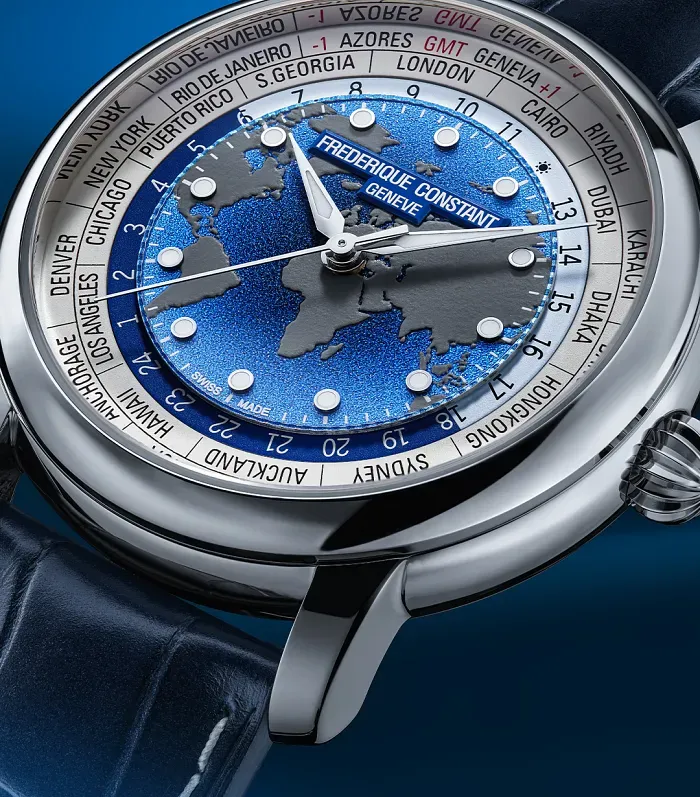 The twenty-four city names, the day and night disc, and the engraved world map. Photo: Frederique Constant (frederiqueconstant.com).
The real engineering achievement, though, is not on the dial but in how you set it. World timers typically work with hidden pushers or separate correctors, which often need a little tool as well. The FC-718 caliber, by contrast, handles everything from a single crown: winding, the date, the city disc and the time. There are three crown positions, and in the second one, turning it upwards sets the date while turning it downwards moves the city disc. When you set the time, the twenty-four hour disc falls into place by itself.
This is exactly the kind of solution I like: not showy, nothing to boast about over dinner, but something you feel every single time you use it, because somebody thought it through.
Where it really is not the best
Let me be honest, because without this the piece would be worth nothing.
The FC-718 runs with a thirty-eight hour power reserve at 28,800 vibrations per hour. By modern standards the power reserve is modest: take it off on Friday evening and it will certainly have stopped by Monday morning. There are watches at this price that manage eighty hours.
The decoration, on the other hand, is surprisingly lovely: perlage, circular Geneva stripes, blued screws, polished edges and an openworked gold-tone rotor. It is industrially executed, so not hand-applied anglage, but the view through the caseback really does reward turning the watch over.
And the big question everyone asks at this point: do I need twenty-four time zones? Honestly, most of us do not. This complication was originally made for people who genuinely work across zones. In practice this is a watch whose usefulness is rarely activated, while the dial reminds you at every glance that the Earth is turning.
Why it stayed with me
What I like about this watch is the outlook behind it. The story of Frederique Constant is about two people with no connection to the industry deciding, at the worst possible moment, to make the thing that was missing: proper Swiss mechanics at a price an ordinary person can pay. And the Worldtimer is the purest embodiment of that idea. A complication that used to exist only in the world of Patek and Vacheron was given an in-house movement here, and an operation that is genuinely simple.
This is not the best watch. It wins no contest on any measure. It is just that it still comes to mind whenever the subject comes up, that somebody rolled up their sleeves and made it.
The object, not the hype. Sometimes quite literally.