Today we take it for granted that when it is noon in Budapest it is six in the morning in New York. Yet this whole system is barely a hundred and fifty years old, and it was not born of some lofty idea but of a very mundane problem: the trains could not write a timetable.
This piece is about how the chaos became twenty-four zones, and how all of that was made to fit on a single dial.
When every town kept its own hour
Before the railways, time was a local matter. Every settlement declared noon when the Sun stood highest above it. That is perfectly logical, and perfectly useless the moment anyone starts travelling quickly.
If a train sets off eastward, the time is slightly different at every stop, because the Sun reaches its highest point at a different moment. A few minutes either way, except that writing a timetable from that is impossible, to say nothing of avoiding collisions.
The solution was championed from the 1870s by a Scottish-born Canadian engineer, Sandford Fleming: divide the Earth into equal bands, and within a band let everyone use the same time. The breakthrough came in 1884, when an international conference adopted the Greenwich meridian as the zero point, and from that came the twenty-four time zones.
This is the moment that gives the world timer as a complication any meaning at all. As long as everyone kept their own time, there was nothing to put on a dial. Once there were twenty-four well-defined zones, though, the question suddenly arose: could they be shown all at once?
A watchmaker in the back room of his wife’s stationery shop
The answer was found by Louis Cottier, born in 1894 in Carouge, just outside Geneva.
His father, Emmanuel Cottier, was himself a watchmaker and inventor, and had presented a world time system as early as 1885. It was not a success, but the idea was there, and his son later carried it forward.
Louis studied at the Geneva horological school, where he won several prizes, two of them from Patek Philippe itself, and then worked in Jaeger’s Geneva workshop. After the Great Depression, however, he lost his job and set up a workshop at home, in the back room of his wife’s book and stationery shop.
There, in those distinctly unglamorous surroundings, he solved in 1931 what everyone before him had failed at.
The idea that is brilliantly simple
Earlier attempts had all fallen into the same trap: they crammed the dial with city names and little hands until the whole thing became illegible.
Cottier’s solution has three elements, and that is exactly why it works.
At the centre, ordinary hour and minute hands show local time. This part is entirely conventional.
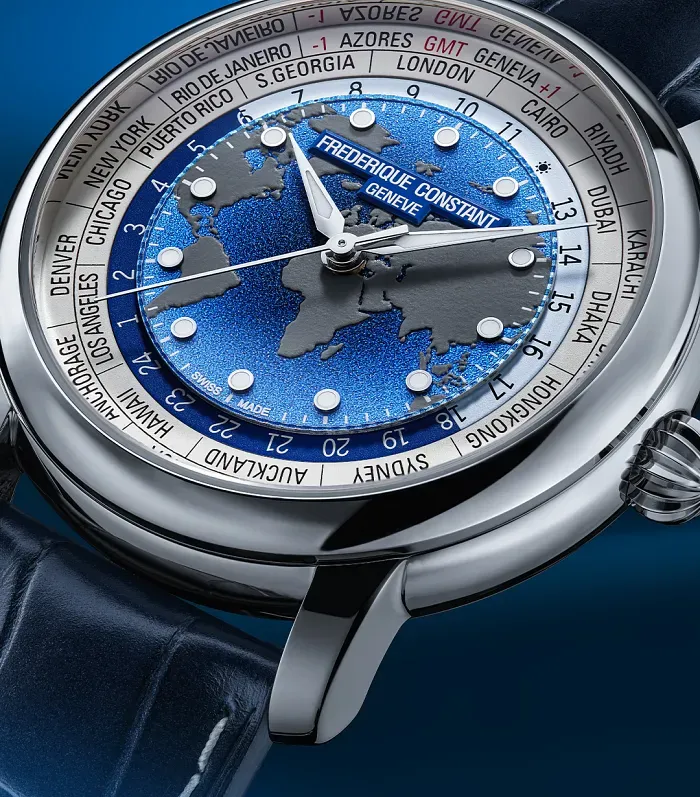
Around them runs a twenty-four hour disc, which makes one full revolution in twenty-four hours, and does so counterclockwise. It carries every hour from zero to twenty-three.
And on the outermost ring stand the names of twenty-four reference cities, one for each time zone.
From here the use is self-evident. You turn your own city to the twelve o’clock position, set local time, and from then on beside every other city name stands the hour it is there. No mental arithmetic, no need to know the size of the offset.
There is a small bonus built in too: one half of the twenty-four hour disc is light and the other dark. Where a city name falls on the dark section, it is night there. That is why no separate day and night indicator is needed.
The world timer in motion
Choose a city and see how the city ring and the twenty-four-hour day–night disc turn into position.
The model loads only when you start it.
An interactive model, running on real time: choose any city and watch it turn to the twelve o’clock position while the twenty-four-hour disc falls into place. From then on, the local time can be read beside every city name.
The career that ran under other people’s names
Cottier patented the system in 1931, calling it Heures Universelles, meaning universal hours.
He made his first world timer as a pocket watch, for a Geneva jeweller named Baszanger. From there, though, the great houses noticed him very quickly. Vacheron Constantin commissioned a pocket watch from him in 1932, and by 1937 Patek Philippe wanted the complication on the wrist: hence the rectangular 515 HU and the 96 HU in a Calatrava case. The latter is now among the most sought-after Pateks in existence.
Cottier also worked for Rolex and for Agassiz, which we know today as Longines. The interesting part is that his own name almost never appeared on the dials: the watches carried the names of the clients. He made roughly four hundred and fifty movements in total, of which about three hundred and eighty went to Patek Philippe, between 1937 and 1965.
One refinement is worth singling out. Originally the city disc had to be set with the same crown as the time, which was cumbersome. So in 1953 Cottier added a second crown to control the twenty-four hour ring independently. That solution debuted on Patek’s reference 2523, still one of the legendary world timers.
Cottier died in 1966, and after his death Patek’s world timer production faded for a while. It only resumed in 2000. The layout he devised, though, lives on virtually unchanged. If you pick a world timer off the shelf today, whether a Patek Philippe or something far more attainable, you are holding a nearly hundred-year-old Geneva idea.
World timer and GMT, because they are not the same
These two are often confused, though the difference is simple.
A GMT watch shows one extra time zone, typically with a fourth hand that goes round once in twenty-four hours. That suits anyone for whom one other zone matters: home time, or wherever the family is.
A world timer, by contrast, shows all twenty-four at once. That is more spectacular, but it comes with a busier dial, and reading it takes a moment longer.
Roughly, this is how to choose between them: if you follow one other zone regularly, you want a GMT. If you want to see the whole planet, you want a world timer.
Two things a world timer cannot do
And now the part brands rarely mention, though it is what completes the picture.
The first problem is the half-hour zones. The system is built on twenty-four whole-hour bands, except that reality is not that tidy. In India the offset is five and a half hours, in Nepal five hours forty-five minutes, and there are several similar cases. A classic world timer simply cannot show these, because the twenty-four hour disc is divided into whole hours only.
The second is daylight saving time. The city disc is fixed, while daylight saving shifts the real time twice a year, and not everywhere, and not at the same moment. So a world timer becomes inaccurate for half a dozen cities at a time, and the wearer has to correct for it in their head.
This is not a fault but the natural limit of the complication. A world timer displays the logic of 1931 on a planet that has grown a good deal untidier since. To my mind that only makes it more interesting.
Why I love this complication
The world timer is special because it does not show more data, it shows something different: not only what time it is, but where the world currently stands.
There is something oddly reassuring about it. You glance at your wrist and see that while you sit here, they are already asleep in Tokyo, and in Los Angeles the day is only just beginning. A mechanism that reminds you the Earth is turning.
Cottier worked it out in the back room of a stationery shop. The object, not the hype.