The world’s most famous space watch was never made for space. In 1957, when Omega introduced the Speedmaster, it was a racing chronograph, meant for motor-racing drivers. NASA did not order it; it simply bought one off the shelf and chose it through brutal testing. And while we are on the subject of legends: the first watch on the Moon was not even Neil Armstrong’s. Let’s start at the beginning.
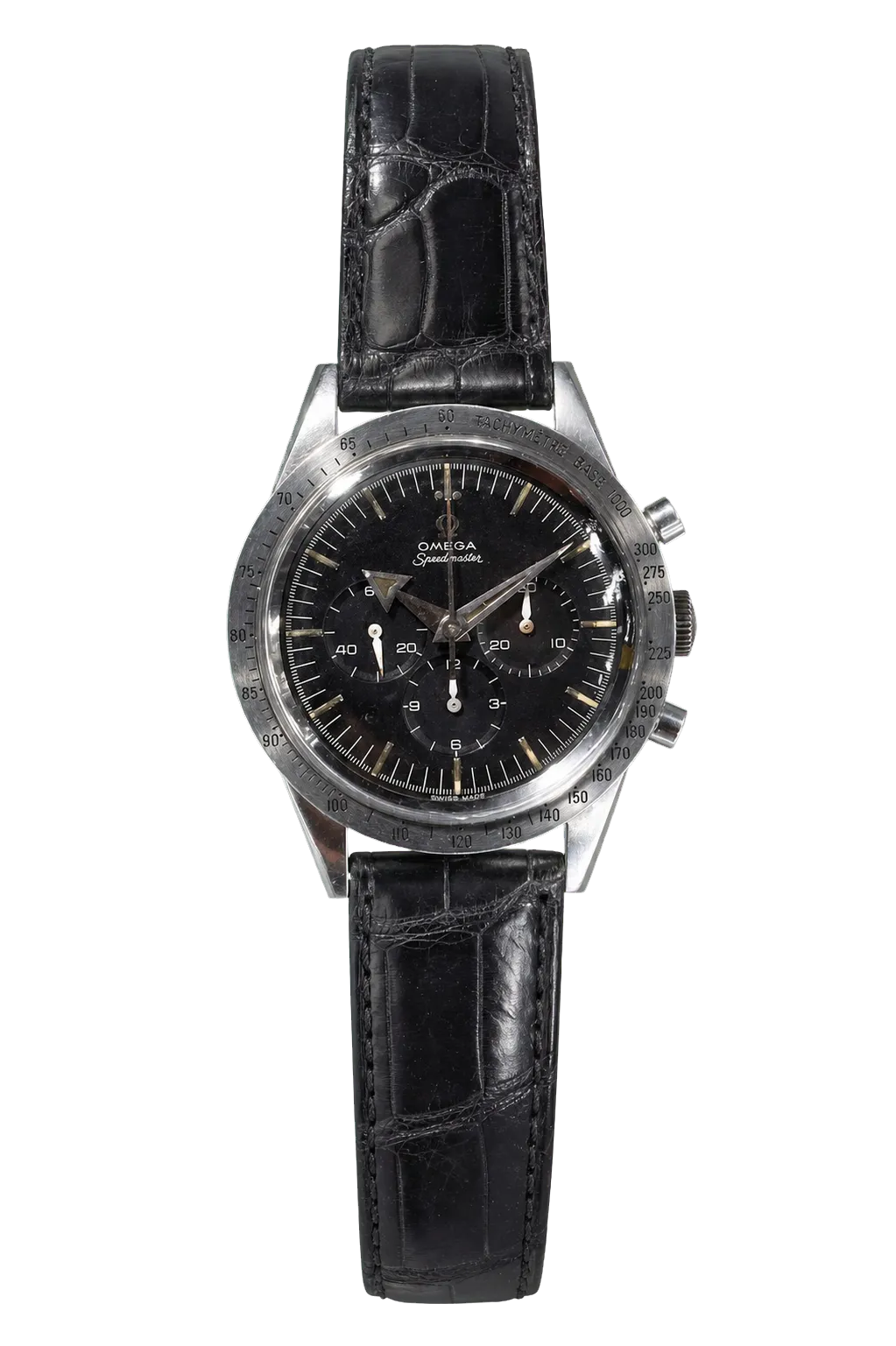 The first Speedmaster, the CK2915 (1957), with broad arrow hands. Source photo: Fratello Watches (fratellowatches.com); background extraction and image completion: Lume, with AI assistance.
A racing watch from 1957
The Speedmaster was born in 1957, as part of a three-piece Omega line-up (alongside the Seamaster 300 and the Railmaster). It was designed as a racing chronograph, and that is where its name comes from. In that era the tachymeter scale usually sat on the dial; Omega moved it onto the bezel, so the dial stayed cleaner and more legible. It was the first chronograph with the tachymeter running around the bezel.
The hands were the distinctive broad arrow shape, and the movement was the legendary Caliber 321: a hand-wound, column-wheel chronograph built on the Lemania 2310, whose roots go all the way back to 1942. If you have read my piece on the column wheel, this will sound familiar.
NASA did not design it, it chose it
A few years later NASA was looking for a chronograph that could survive space. It did not have one designed; it approached ten manufacturers for quotes, and to avoid favouritism, it bought the sample watches anonymously from a jeweller in Houston. Four responded: Rolex, Longines-Wittnauer, Hamilton and Omega. Hamilton was disqualified at once, because it sent a pocket watch instead of a wrist chronograph. Three were left: the Rolex 6238 and the Longines-Wittnauer 235T (both with the Valjoux 72), and the Omega Speedmaster 105.003 with its Lemania-based 321.
Then came the torture. They were baked, frozen, put in a vacuum, shaken, shocked and steamed. The Rolex stopped in the heat and its hands warped; the Longines-Wittnauer’s crystal shattered. Only one watch was left standing: the Omega Speedmaster (its lume scorched a little, and it ran fast under vibration, but it never stopped). On March 1, 1965, NASA officially declared it “Flight Qualified for All Manned Space Missions”.
Omega, the story goes, learned the news from a photograph: on the first American spacewalk (1965, Gemini 4) Ed White wore a Speedmaster over the sleeve of his suit. The word “Professional” appeared on the dial shortly afterwards. The point stands: it was not invented for space, it was chosen on merit.
Apollo 11, and the watch that stayed behind
And here is the loveliest “fact behind the legend”. On July 20, 1969, Neil Armstrong and Buzz Aldrin landed on the Moon, both with the reference 105.012 Speedmaster. But the lunar module’s electronic timer had failed, so Armstrong left his own watch inside the Eagle as a backup timer. So when they stepped out onto the surface, it was the Speedmaster on Aldrin’s wrist (on a long Velcro strap, over the suit) that became the first watch worn on the Moon. Not Armstrong’s, but Aldrin’s.
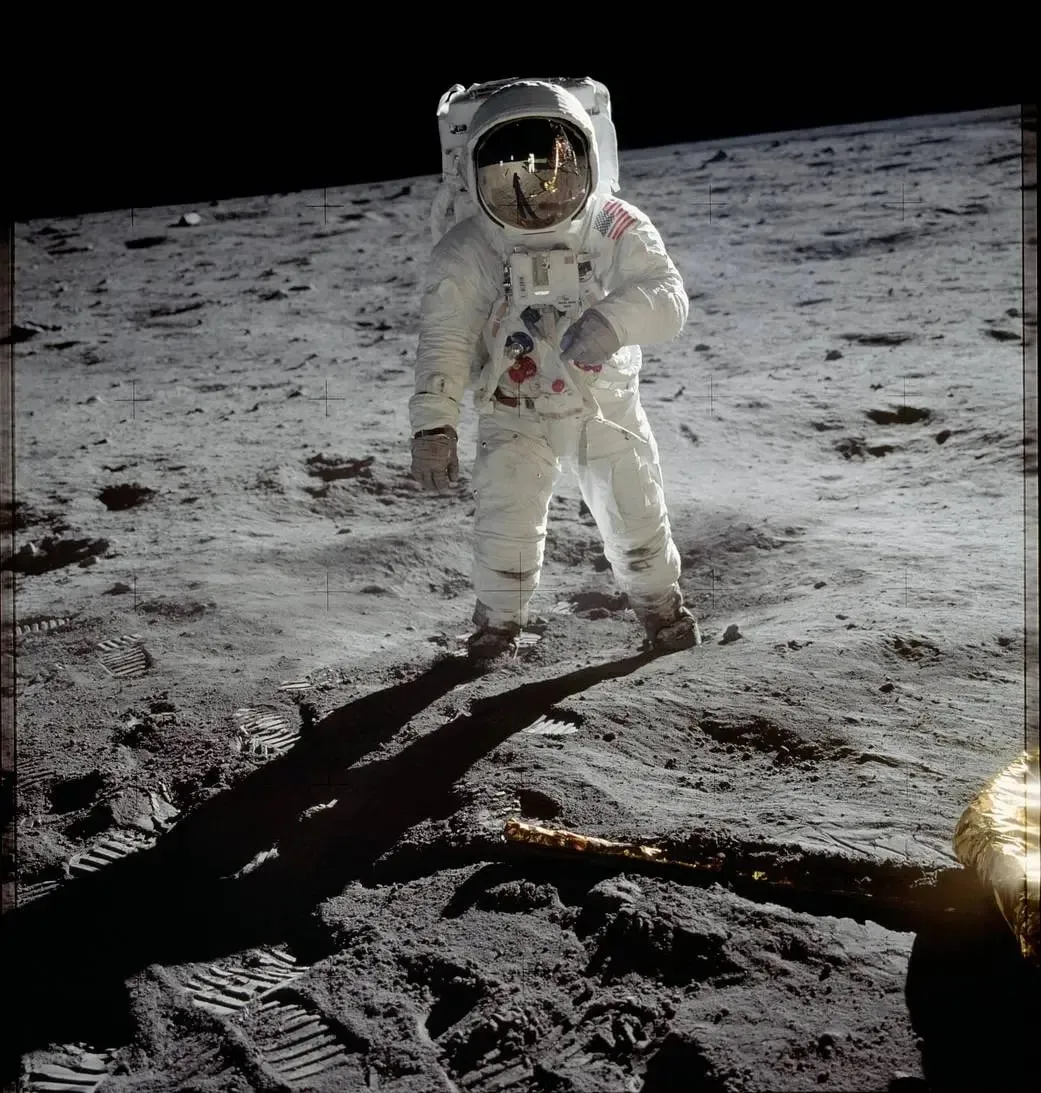 Buzz Aldrin on the Moon, with the Speedmaster over his suit (Apollo 11, 1969). Photo: NASA (nasa.gov), public domain.
Apollo 13, the real high point
The Speedmaster’s most important moment, though, was not the landing but a rescue. In 1970, on the Apollo 13 mission, an oxygen tank exploded; the crew had to shut down the command module, and the digital mission clock went dark. To get home, they had to correct their trajectory precisely: too steep and they would burn up, too shallow and they would skip back off into space.
They restored the trajectory with a manual, 14-second engine burn, and they timed it on Jack Swigert’s Speedmaster. The mechanical watch did its work where the electronics had fallen silent. For this, in 1970, Omega received NASA’s Silver Snoopy Award, one of the agency’s highest honours for a contribution to flight safety.
This award later came back on the watches themselves. Omega made several “Silver Snoopy Award” special editions: in 2003 a run of 5,441 pieces (the number refers to the time Apollo 13 spent in space), in 2015 a white-dial version of 1,970 pieces with the words “What could you do in 14 seconds?”, and in 2020, for the fiftieth anniversary, one whose sapphire caseback shows an animated Snoopy orbiting the Moon every time you start the chronograph.
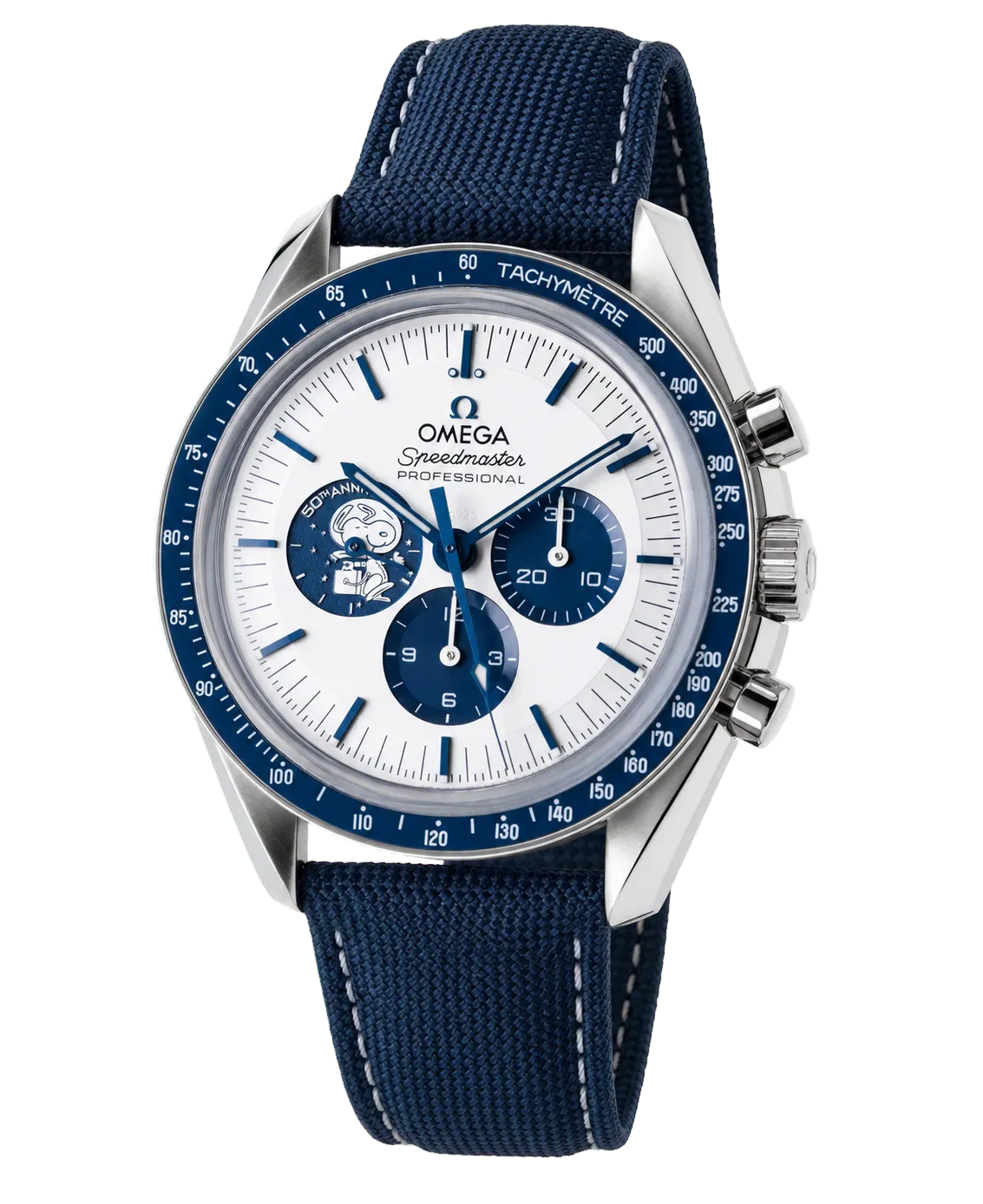 The 2020 “Silver Snoopy Award”, with its animated caseback. Source photo: Chrono24 (chrono24.com); background extraction and image completion: Lume, with AI assistance.
The watch that has barely changed
Around 1968 the Caliber 321 was replaced by the 861: essentially the same movement, simplified for manufacture, with the column wheel swapped for a switching cam (exactly the transition I wrote about in the Movement column). Since then the 861 has evolved through the 1861 to today’s 3861, but the essence of the Moonwatch has barely changed: hand-wound, a hesalite (Plexiglas) crystal, the same dial. To this day it is the only watch NASA qualifies for spacewalks.
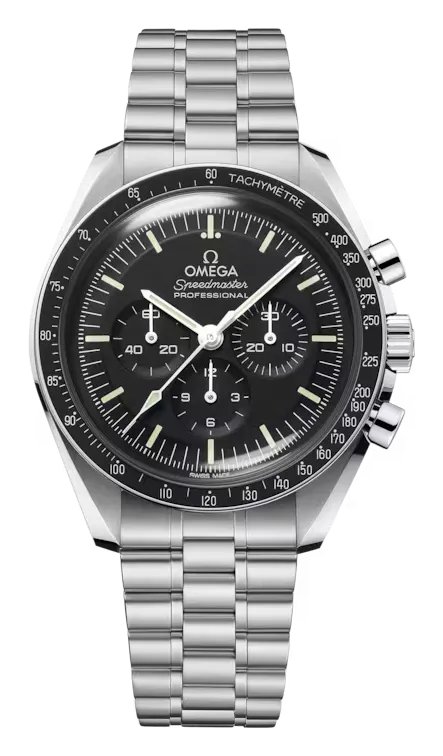 The Moonwatch Professional today, in a barely changed form. Photo: Omega (omegawatches.com)
When the Speedmaster became plastic
In March 2022, Omega and Swatch jointly released the Bioceramic MoonSwatch: the shape of the Moonwatch poured into a roughly 260-dollar quartz watch with a plastic-ceramic case, in eleven colours named after the bodies of the Solar System. It was available only in physical Swatch stores, and at launch it produced queues, crowds and pieces resold at a premium all over the world. It became a cultural phenomenon, far beyond watch circles.
 The 2022 Bioceramic MoonSwatch, a joint piece by Omega and Swatch. Photo: Time+Tide (timeandtidewatches.com)
Whether this is good or bad is still debated, and in its own way each side has a point.
One view is that it is democratisation: someone who cannot spend several thousand dollars on a Speedmaster can now wear a piece of that same iconic form, and the enormous attention brought many new, young people into the world of watches. From this angle the MoonSwatch opened the door rather than devaluing anything.
The other view is that it is dilution: a legendary design appearing on a cheap plastic quartz watch can wear away the prestige of Omega and the Speedmaster, and the dozens of variations released over two and a half years can create a sense of “burnout”. For those who see it this way, the value of the real Moonwatch comes partly from its very rarity and seriousness, which the mass-market plastic version can chip away at.
The truth is probably somewhere between the two, and time will tell which effect lasts longer. It is not for me to decide here: what matters is that this too has become part of the Speedmaster’s story.
This is why the Speedmaster belongs in this column. It was not marketing that made it a legend, but the fact that it worked when it counted. The object, not the hype. A racing watch from 1957 that reached the Moon simply because it was the best tool for the job.