Lume Workshop / Interactive model
When the blade snaps
Start with one elastic part. Then follow energy through the watch. Two experiments with separate, stated assumptions.
When the blade snaps
Start with one elastic part. Then follow energy through the watch. Two experiments with separate, stated assumptions.
Find it in the watch
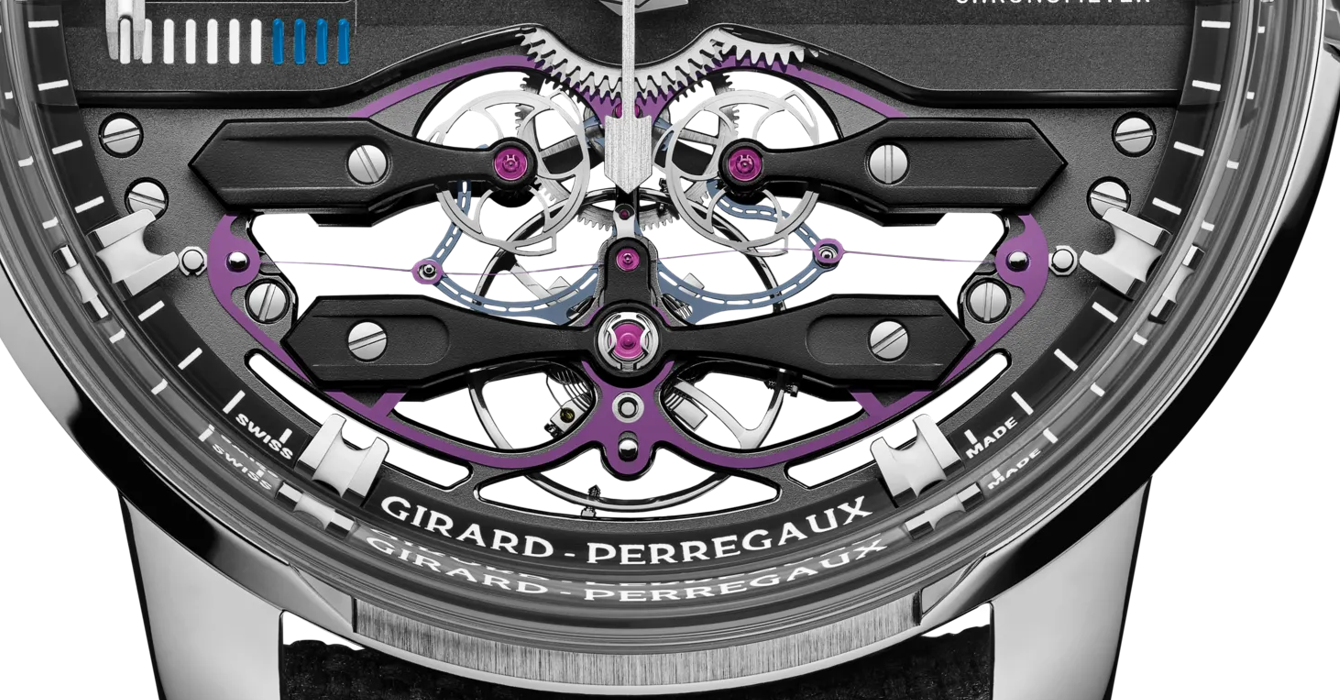
The blade runs approximately horizontally inside the purple frame. The balance is visible behind the lowest black bridge. Central connections give the production blade a wave-like shape. The simpler beam below makes its change of stability easier to follow.
One blade, two places to rest
The fixed ends impose a small compression. The strip can rest bowed towards either side. The coloured ribbon is an enlarged principle beam, not the complete production silicon assembly.
Drag the drawing to rotate the view.
External loading increases and reverses automatically. The physical model still calculates the blade motion.
Potential energy
Shape / q · Relative energy
Impulse sequence
1 = a prepared dose was delivered. 0 = no dose was ready for that beat.
Charging
All values are relative. No µJ or measured microseconds.
What is calculated?
Blade mode is a damped single-coordinate mechanical approximation. The spatial ribbon visualises that coordinate. It is neither a finite-element material model nor scale CAD of the GP09200. Energy-metering mode is a separate teaching state machine. Numbers from the two experiments cannot be interchanged. Six half-oscillations per second is a manufacturer specification. The teaching rhythm here is deliberately slower.
Beam model: U(q) = (q² − 1)² / 4. Motion: q″ + 0.45q′ + q(q² − 1) = F. RK4 integration with steps no larger than 1/240. The separate metering model assumes unit doses and keeps its own energy balance.